
Reviewed · MEXICO CITY
Arrivals & Survival of Jews in Mexico from 1519
Mexico City’s Centro Histórico holds a Jewish story that is easy to miss. This small-group walking tour brings it into view, moving from the ruins of the Great Aztec Temple and Spanish colonial power to the first Sephardic and Ashkenazi synagogues in Mexico.
I like the opening terrace conversation at Librería Porrúa, which gives you a calm place to understand the city before the walk begins. I also like the final stop at the old Justo Sierra Synagogue, where the history becomes personal and architectural rather than just a string of dates. The main drawback is that the Jewish subject shares space with a broad history of Mexico, the Church, and the Inquisition, so this may feel less focused than the title suggests.
In This Review
- Key points at a glance
- A Jewish history tour hidden inside Mexico City’s old center
- Starting at Librería Porrúa above the Great Aztec Temple
- Behind the Metropolitan Cathedral and the Chapel of the Souls
- Santo Domingo and the old trading center
- The Palace of the Inquisition and the Perpetual Prison
- San Ildefonso, Rivera, Kahlo, and Trotsky
- Plaza Loreto and Mexico’s first purpose-built synagogues
- Inside the decommissioned Justo Sierra Synagogue
- How much walking and how personal is the experience?
- Is $99 a fair price?
- Who should book this Mexico City Jewish history walk?
- Should you book it?
- FAQ
- How long does the tour last?
- What time does the tour begin?
- Where does the tour start?
- Where does the tour end?
- Is the tour offered in English?
- How many people can join the tour?
- Can I cancel for a full refund?
Key points at a glance
- Start above the Aztec Temple ruins: Begin with a sit-down introduction at Librería Porrúa and a view over one of Mexico City’s most important archaeological sites.
- Follow the Inquisition’s footprint: See the Chapel of the Souls, Santo Domingo, the Palace of the Inquisition, and the former Perpetual Prison.
- Connect Jewish and Mexican art: Learn about Diego Rivera and Frida Kahlo at the former San Ildefonso school.
- Visit two important synagogues: End near Plaza Loreto at the former Justo Sierra Synagogue, linked to Mexico’s first Ashkenazi congregation.
- Expect a very small group: The tour accepts no more than 10 people, allowing plenty of room for questions.
- Plan for a history-heavy walk: The guide covers Jewish life, Spanish rule, colonial religion, anti-Fascism, Trotsky, and modern Mexican identity.
A Jewish history tour hidden inside Mexico City’s old center
This experience covers about three and a half hours and costs $99 per person. That is not a bargain-priced city stroll, but it can be good value if you want a specialist history tour rather than a quick look at the Centro Histórico’s standard sights.
The price includes a local guide and access arrangements for some public and private places. Most of the route is outdoors, with stops at churches, plazas, historic buildings, and synagogues. You are paying mainly for the guide’s explanation and the unusual route, not for a long list of admission tickets.
Carlos is the guide most often associated with this experience. His approach, based on the tour’s format, combines Mexican history with Jewish history and personal interpretation. He speaks English and is described as especially good at handling questions, placing events in a wider world context, and making the material accessible.
That last point matters. The subject reaches from the arrival of the Spanish in 1519 through the Inquisition, the colonial trading system, modern art, Jewish migration, anti-Fascist politics, and Mexico’s reception of Leon Trotsky. Without a strong narrator, this could become a jumble of names and dates. With Carlos, the route is designed as a timeline.
Still, you should know what kind of tour this is. It is not a synagogue-only visit, and it is not a formal academic seminar. You will spend considerable time learning about the Spanish Empire, Catholic power, colonial Mexico, and the city itself. One past participant felt that only about an hour of the four-hour experience dealt directly with Jewish history. If you want a tightly focused Jewish community tour, ask yourself if that wider setting is a benefit or a distraction.
Other Mexico City days people book alongside this one:
- Teotihuacan, Guadalupe Shrine & Tlatelolco Day Tour with Lunch
★ 5.0 · 11,603 reviews - Xochimilco, Coyoacan and Frida Kahlo with Optional Lunch
★ 4.5 · 7,320 reviews - Balloon flight + Breakfast in cave + Pyramids + Pick up CDMX.
★ 5.0 · 6,335 reviews
Starting at Librería Porrúa above the Great Aztec Temple
The tour begins at República de Argentina 15, at Librería Porrúa in the Centro Histórico. The 10:00 am start gives you a full morning before the afternoon heat and crowds build.
The first hour is based around an introductory conversation from the bookstore’s terrace. You look toward the ruins of the Great Aztec Temple while the guide sets up the central idea: Mexico City has long been shaped by different religious and cultural forces existing side by side, sometimes peacefully and sometimes under pressure.
This is a smart beginning. Instead of dropping you straight into a church or synagogue, the guide starts with the city’s oldest visible foundations. The view also helps you understand how tightly packed the historic center is. Pre-Hispanic ruins, colonial churches, modern shops, and later Jewish institutions all occupy the same small area.
The format is unusually relaxed for a walking tour. You may have coffee or a snack while listening, though the supplied details do not promise that these are included in the price. Think of the opening as a seated orientation, not a museum visit. Admission to the stop is free.
If you prefer constant movement, the first hour may feel slow. I think it works well for anyone who wants context before facing the harder parts of the story.
Behind the Metropolitan Cathedral and the Chapel of the Souls
From the bookstore, the group walks behind the Metropolitan Cathedral to the Chapel of the Souls. The stop lasts about 20 minutes and does not require a separate admission ticket.
Here the guide explains how religious teaching against heresy and other faiths appeared in colonial Mexico. The viewpoint also allows you to examine the cathedral’s colonial design and the ways religious authority shaped public space.
The tour presents this part of the city as more than beautiful architecture. The cathedral represents the official Catholic order imposed by Spain, while the Jewish story often survives in partial records, coded signs, forced conversions, and accounts of people who practiced privately.
You should expect a discussion of the Spanish Inquisition and its effect on Jews and other religious groups. The language and subject matter may be uncomfortable. That is part of the value, but this is not a light sightseeing walk. The guide’s task is to explain how architecture, law, public ritual, and surveillance worked together.
The stop is brief, so you will not spend a long time inside a religious building. Much of the value comes from knowing what to look for and why the location matters.
Santo Domingo and the old trading center
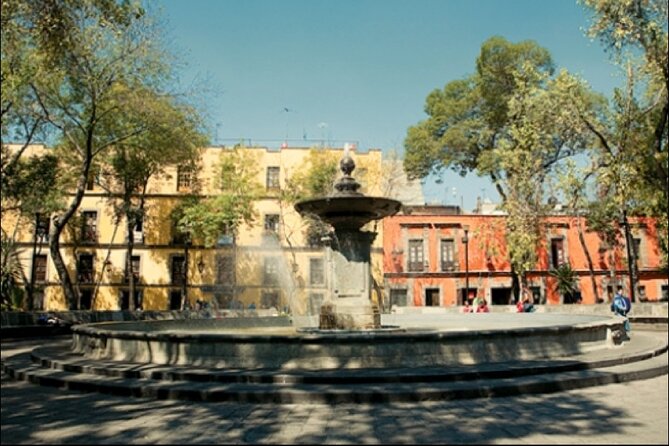
The walk continues to Plaza de Santo Domingo, once a major marketplace from the 16th through the 19th centuries. You spend about 20 minutes here.
The guide connects the plaza to Jewish merchants who had to trade in public while trying to keep their religious identity private. The story is tied to the Palace of the Inquisition, where traders were watched, and to Santo Domingo church, located at the beginning of El Camino Real.
This is one of the route’s most useful ideas: Jewish life in colonial Mexico was not limited to worship. It was also tied to commerce, travel, family networks, and the risks of being visible. A marketplace can look ordinary until you understand who had to pass through it and who was observing them.
The tour also asks you to examine hidden anti-Semitic messages connected with the palace and church. This is where the guide’s visual explanations become important. You are not simply told that intolerance existed. You are directed toward signs and spaces that express it.
The drawback is that the history here can be dense. If the guide moves quickly through Spanish legal terms, colonial institutions, or the different categories of Jewish converts and people practicing in secret, ask questions. The group limit of 10 should make that possible.
A completely different day out, same corner of Mexico City:
- Teotihuacan pyramids morning or afternoon without tourist traps
★ 5.0 · 6,186 reviews - Teotihuacan Early Access Guided Tour with optional Lunch
★ 4.5 · 6,138 reviews - Balloon flight + pick up in CDMX + Breakfast in Cave + Pyramids
★ 5.0 · 5,651 reviews - Balloon Flight + Cave Breakfast + Pick Up from CDMX or We Fly
★ 5.0 · 4,410 reviews
The Palace of the Inquisition and the Perpetual Prison
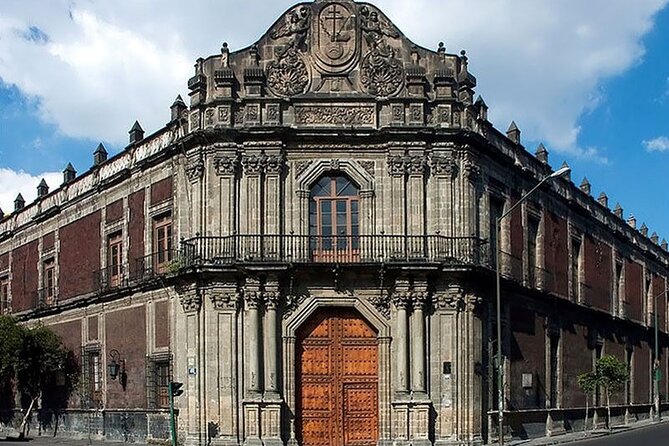
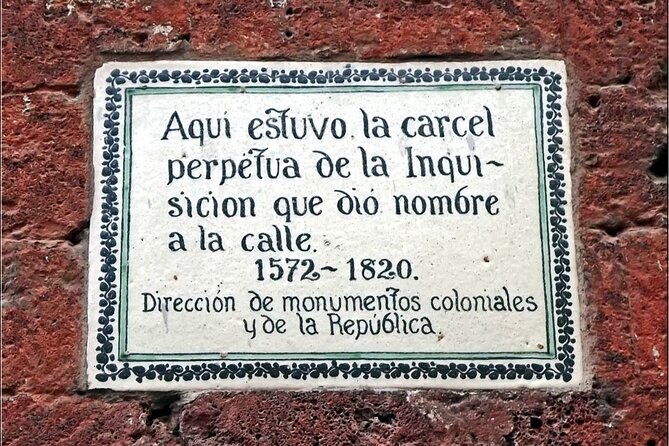
The next stop takes about 20 minutes and passes the former administrative building of the Inquisition, its living quarters, and the Perpetual Prison.
This section gives the tour its darkest setting. The buildings were not only offices. They were part of a system that investigated belief, punished religious difference, and used imprisonment and torture. The experience presents Jews as part of a larger group caught in a colonial system built around religious conformity.
You will hear about people who were sentenced to death, but the supplied information does not promise entry into every building. Much of the stop takes place from the street. That means the guide’s account matters more than the physical access.
I appreciate the way this stop ties the earlier marketplace to the machinery of control. At Santo Domingo, you learn about surveillance in daily life. Here, you see the institutions behind it. The route becomes easier to follow because each place adds another piece to the same story.
This is also where the tour can feel broader than its title. The subject is Jewish survival, but the guide is also explaining colonial government, Catholic power, and the history of Mexico City. You will get more from the walk if you are happy to learn both at once.
San Ildefonso, Rivera, Kahlo, and Trotsky
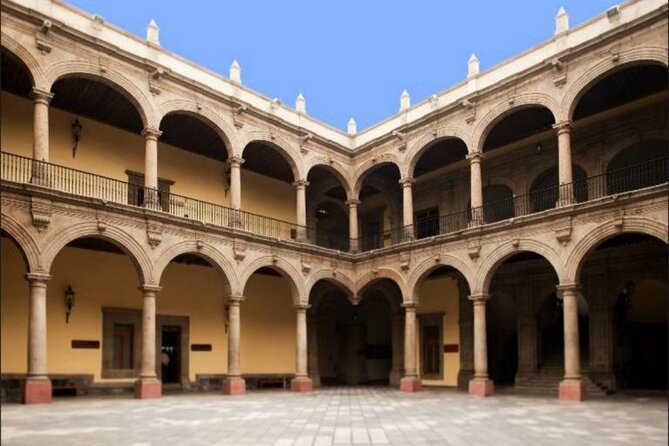
At the former Antiguo Colegio de San Ildefonso, the group stops for about 15 minutes. The building is viewed from outside.
The guide uses this location to explain where Diego Rivera and Frida Kahlo’s paths crossed. The tour presents Rivera as having Sephardic roots and Kahlo as having Ashkenazi roots, then connects their circles to Mexico’s anti-Fascist movement.
This is an appealing change of pace. After the oppression of the Inquisition, you move into art, politics, identity, and the modern city. The Jewish story is no longer only about hiding or persecution. It becomes part of Mexico’s cultural and political life.
You also learn how Mexican anti-Fascists helped cancel the first and only anti-Semitic national convention and supported Mexico’s welcome to Lev Davidovich Bronstein, better known as Leon Trotsky. These details broaden the experience beyond synagogue architecture and colonial history.
Do not expect a full Diego Rivera or Frida Kahlo art tour here. The stop is short and takes place outside San Ildefonso. It works as a historical connection, not as a substitute for the Frida Kahlo Museum or a dedicated mural tour.
Plaza Loreto and Mexico’s first purpose-built synagogues
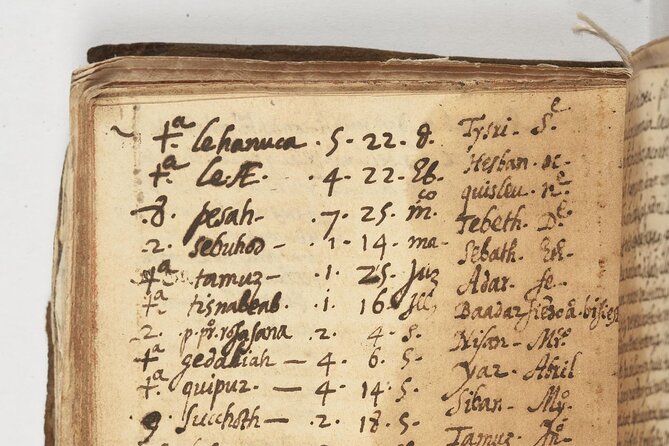
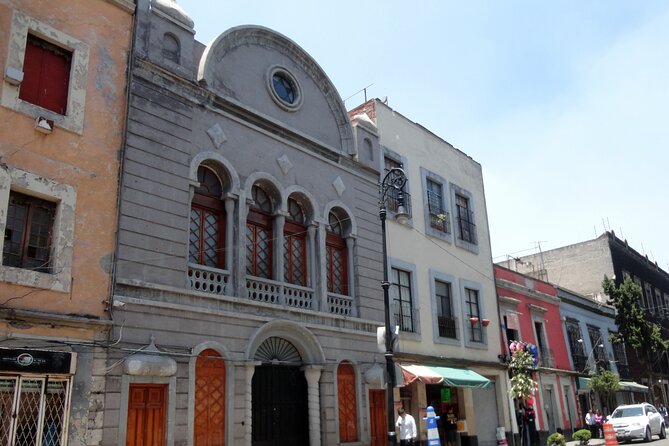
The route then reaches Plaza Loreto, where the group passes the first purpose-built Sephardic synagogue in Mexico, Mount Sinai, and the neighboring Nidjei Israel, identified as the first Ashkenazi synagogue in Mexico. This stop lasts around 15 minutes.
For many people, this is the point when the earlier history becomes easier to picture. The colonial streets and Inquisition buildings explain the dangers and pressures faced by Jewish people in Mexico. These synagogues show organized community life taking shape in a later period.
The distinction between Sephardic and Ashkenazi traditions is central here. The tour does not treat Jewish history as one single story. It points to different migration backgrounds, institutions, and community identities.
The location near Plaza Loreto also makes the route feel connected rather than scattered. You are not being driven across Mexico City from one isolated site to another. The route stays in the old center, and the final synagogue is close to the plaza.
The stop is short, so you should not expect a long service, religious program, or extensive indoor visit at both synagogues. The main experience is the guide’s explanation of what these buildings represent.
Inside the decommissioned Justo Sierra Synagogue
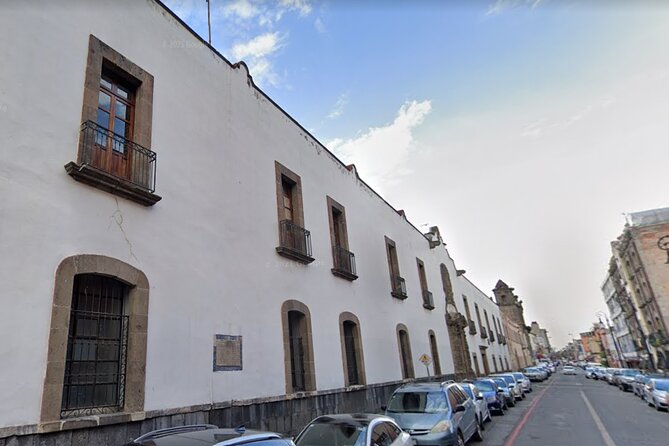
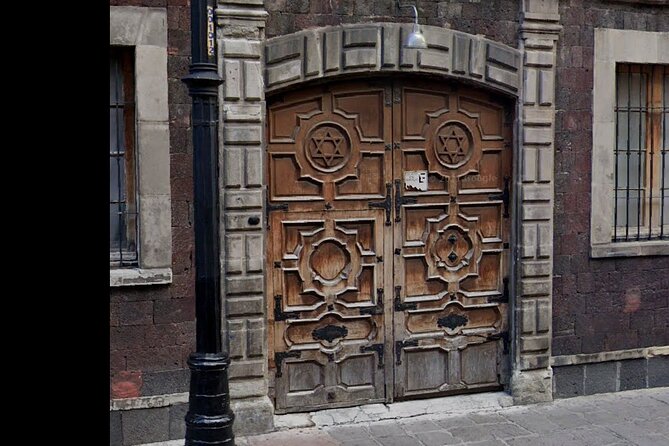
The final stop is the Justo Sierra Synagogue at Justo Sierra 71, directly in front of Loreto Park on the south side of Justo Sierra Street. The tour ends here after another 20 minutes.
This is the first Ashkenazi synagogue in Mexico and is now decommissioned. Its former religious purpose gives the building a particular power. You are looking at a place that once served a living congregation, not simply a monument designed for tourists.
The ending is well chosen. The tour begins with a broad view of Mexico City and finishes with a specific community institution. You move from ruins and grand colonial buildings to a synagogue tied to migration, worship, and local Jewish life.
Access arrangements for some private places have been agreed in advance, and the tour information indicates that entrance to some such locations is included or waived. Exact access can vary, so I would not assume every building on the route is open in the same way on every date.
The synagogue is also the strongest reason to book if architecture and community history interest you. If your main goal is to visit active congregations or attend a service, this experience may not meet it, since the final synagogue is decommissioned and the tour is historical.
How much walking and how personal is the experience?
The route lasts about three and a half hours, but it is broken into many short stops. Several people found the walking manageable, with no long stretch of walking all at once. You still need a moderate level of fitness because you are moving through the Centro Histórico, crossing streets, and standing at historic sites.
Wear comfortable shoes and bring water. The experience is offered in English and uses a mobile ticket. It operates near public transportation, so reaching the central meeting point should be practical, though the supplied details do not specify a particular metro station or bus route.
A maximum of 10 participants is a real advantage. A small group gives you a better chance to hear the guide in noisy streets and ask about family history, religious customs, or the political events being discussed.
The guide can make or break the morning. Carlos receives particularly strong praise for his clarity, warmth, personal connection, and ability to answer detailed questions. He also brings in modern perspectives on Mexico’s Jewish community. Since guide assignments can vary, you should confirm who will lead your departure if that matters to you.
The tone may not suit everyone. One description of the approach found the Socratic style less useful, and another felt that some explanations were too basic or simplified. I would come ready to ask for more detail rather than expect a university lecture with a reading list.
Is $99 a fair price?
At $99, this is a premium walking tour for Mexico City. Most stops have no separate admission charge, so the value rests in the small group, the route, the local guide, and access arrangements rather than in paid attractions.
I think the price is fair for the right audience: someone interested in Jewish history who wants a guide to connect colonial Mexico, the Inquisition, art, politics, and the city’s first synagogues. It is less attractive if you mainly want a general introduction to the Centro Histórico or a low-cost overview of famous sights.
The published rating is 4.6 from 87 reviews, with 90 percent recommending the experience. The strongest praise centers on the guide’s storytelling, the personal feel of the small group, the visual examples, and the way the tour connects Mexican history with Jewish life.
There are also practical warning signs. Some departures were cancelled at short notice because of a guide health issue or security concerns, including one day affected by a marathon and large crowds. Refund handling created frustration in those cases. The stated policy allows free cancellation up to 24 hours before the start, but last-minute operator cancellations are a separate matter. Keep your booking contact details current, watch messages on the morning of the tour, and avoid placing an important same-day connection immediately afterward.
Who should book this Mexico City Jewish history walk?
You should book if you want:
- A Jewish history route through the Centro Histórico
- A small group with time for questions
- Context about the Spanish Inquisition and colonial Mexico
- Connections between Jewish identity, Mexican art, and politics
- A visit to the first Sephardic and Ashkenazi synagogues
- An English-speaking guide who can discuss both Jewish and Mexican history
You may want another tour if you need a tightly focused account of the modern Jewish community, extensive synagogue interiors, or a short sightseeing walk with little political and religious discussion.
Families with older children and teenagers may enjoy the Rivera, Kahlo, and Trotsky connections. Solo visitors and couples should find the small group comfortable. Anyone sensitive to discussions of torture, execution, anti-Semitism, and forced religious conformity should know that these subjects are central to several stops.
Should you book it?
Book this experience if you want Mexico City to make sense through the intertwined stories of religion, migration, power, art, and survival. The final Justo Sierra Synagogue gives the morning a strong finish, while the opening view over the Great Aztec Temple places the whole story in a much larger frame.
I would not book it simply because you want to see synagogues. You will spend a lot of time learning about Mexico’s colonial system and religious history. But if that wider setting sounds useful, $99 buys a thoughtful, personal route that most standard city walks will not cover.
FAQ
How long does the tour last?
The experience lasts approximately 3 hours and 30 minutes.
What time does the tour begin?
The scheduled start time is 10:00 am.
Where does the tour start?
It starts at Librería Porrúa, República de Argentina 15, in Mexico City’s Centro Histórico.
Where does the tour end?
It ends at Justo Sierra 71, directly in front of Loreto Park on the Justo Sierra Street south side.
Is the tour offered in English?
Yes. The tour is offered in English and uses a mobile ticket.
How many people can join the tour?
The maximum group size is 10 travelers.
Can I cancel for a full refund?
Yes, if you cancel at least 24 hours before the experience start time. Cancellations or changes made less than 24 hours before the start are not eligible for a refund under the stated policy.
Just added around Mexico City
- Mexico City: Hop-on Hop-off City Tour by Turibus 2-Day Pass★ 4.0 · 10 reviews
- Anthropology Museum, Chapultepec Castle & Cable Car Tour★ 4.5 · 10 reviews
- Multi-Variety Mole Class in a Condesa home or art gallery rooftop★ 5.0 · 10 reviews
- PRIVATE TOUR Colonial Town Taxco and Cuernavaca from CDMX.★ 5.0 · 10 reviews
- El Centro Street Food Walking Tour★ 5.0 · 10 reviews
- Private Round-Trip Transportation to Teotihuacan Pyramids★ 5.0 · 10 reviews
- Teotihuacan and My Grandma’s Food Tour★ 5.0 · 10 reviews
- Private Walking Tour Legends and Events Historic Center CDMX★ 4.8 · 10 reviews