
Reviewed · MEXICO CITY
Azcapotzalco: Mexico City’s Culinary Kaleidoscope
Azcapotzalco gives you a side of Mexico City that most visitors never reach. This small-group food walk moves from a simple cafe de olla and sweet bread to elegant huevos encamisados, offal tacos, handmade tortillas, Aztec-era drinks, and a cocktail in a century-old cantina. The food is the route, but the neighborhood’s layered past gives it shape.
I like the small maximum of seven people, which should make it easier to hear your guide and ask questions while standing at food stalls. I also like the range of stops: this is not just a taco crawl, but a look at how family kitchens, street vendors, old industry, and immigrant traditions all share one district.
The main concern is the amount of food packed into a long walking morning and afternoon. If you have a sensitive stomach, take small bites and sips, and think carefully about placing this tour near the end of your Mexico City stay rather than before an important travel day.
In This Review
- Key points to know before booking
- Why Azcapotzalco makes such a good food walk
- Starting with cafe de olla at Arbol de la Noche Triste
- The second breakfast: huevos encamisados and enchiladas
- Offal tacos and the working past of the district
- Handmade tortillas and drinks with Aztec roots
- Ending in a 110-year-old Italian-Mexican cantina
- How much walking and food should you expect?
- Food safety and pacing advice
- Is $140 a fair price?
- Who should book Azcapotzalco Culinary Kaleidoscope?
- Should you book it?
- FAQ
- Where does the Azcapotzalco food tour begin?
- Where does the tour end?
- How long does the tour last?
- What food and drinks are included?
- Is the tour offered in English?
- How large is the group?
- What is the cancellation policy?
Key points to know before booking
- Azcapotzalco beyond the usual route: See a district with a strong local identity rather than staying in Mexico City’s best-known visitor zones.
- A full meal in many chapters: Expect cafe de olla, sweet bread, a second breakfast, juices, tacos, traditional drinks, and cantina dishes.
- A maximum of seven people: The small group suits anyone who values conversation and direct contact with the guide.
- Liz may lead the walk: Her work combines food knowledge with stories about the area and its cooking traditions.
- A serious walking commitment: The experience lasts about six hours, with food spread across several stops.
- Good value for committed food fans: At $140 per person, the price makes the most sense if you want a guided cultural food study, not simply a few inexpensive snacks.
Why Azcapotzalco makes such a good food walk
Azcapotzalco has a personality of its own. The tour uses food to explain that personality, moving through places tied to work, family, migration, and older Mexican customs.
You begin at the Plaza de el Arbol de la Noche Triste in Popotla at 10:00 a.m. The meeting point gives the day a historical frame before you start eating. From there, the route heads into Azcapotzalco, where the stops show different levels of Mexico City dining.
That contrast is the real strength here. You are not asked to choose between a polished restaurant and a street stand. You get both, along with a tortilleria and an old cantina. The result should feel more like a neighborhood portrait than a checklist of dishes.
The walk is offered in English, and guides such as Liz are expected to explain both the food and the area. That matters because several dishes may be unfamiliar, especially the offal tacos and the traditional drinks. With the right explanation, each bite has a place in the story of the district.
Other Mexico City days people book alongside this one:
- Teotihuacan, Guadalupe Shrine & Tlatelolco Day Tour with Lunch
★ 5.0 · 11,603 reviews - Xochimilco, Coyoacan and Frida Kahlo with Optional Lunch
★ 4.5 · 7,320 reviews - Balloon flight + Breakfast in cave + Pyramids + Pick up CDMX.
★ 5.0 · 6,335 reviews
Starting with cafe de olla at Arbol de la Noche Triste
The first stop takes place near the meeting point at Arbol de la Noche Triste. You begin, as much of the neighborhood does, with cafe de olla and sweet bread.
Cafe de olla is spiced coffee traditionally prepared in a clay pot. Even without a long explanation, it is a useful first taste because it introduces you to a Mexican morning habit rather than a restaurant version of breakfast. The sweet bread gives you something mild before the more substantial food begins.
This stop also lets your guide set the tone. The plaza and its name connect the morning to Mexico City’s older story, while the coffee keeps the moment firmly local and practical. You are starting with what people might actually eat and drink, not with a staged tasting.
The timing is worth noting. A 10:00 a.m. start means you should not arrive after a large breakfast. You will need room for several rounds of food, and the opening coffee and bread are only the first course of a long day.
The second breakfast: huevos encamisados and enchiladas
The next stop is the heart of the food experience. At a family-run backstreet restaurant, you sample huevos encamisados, enchiladas, freshly made juices, and other dishes.
The restaurant is described as one of Mexico City’s best, despite its location away from the city’s more familiar dining areas. That combination is important. You are not simply being taken to a famous room with a polished tourist setup. You are visiting a family operation whose appeal is tied to the neighborhood and its regular food culture.
Huevos encamisados are the sort of dish that gives this tour its edge. Even if you already know Mexican breakfast staples, this is likely to be less familiar than standard scrambled eggs or chilaquiles. The name suggests eggs prepared with an outer layer or covering, and your guide can provide the explanation that makes the dish easier to understand.
Enchiladas add a more recognizable point of reference, while the juices bring freshness after the coffee and bread. The meal is substantial, so pace yourself. It is easy to treat the first restaurant as the main event and then discover that the tour has several more stops ahead.
I especially like this part for anyone who wants to understand how Mexico City’s food culture works at more than one level. A family restaurant can serve careful, memorable food without needing a famous address or a fashionable neighborhood.
Offal tacos and the working past of the district
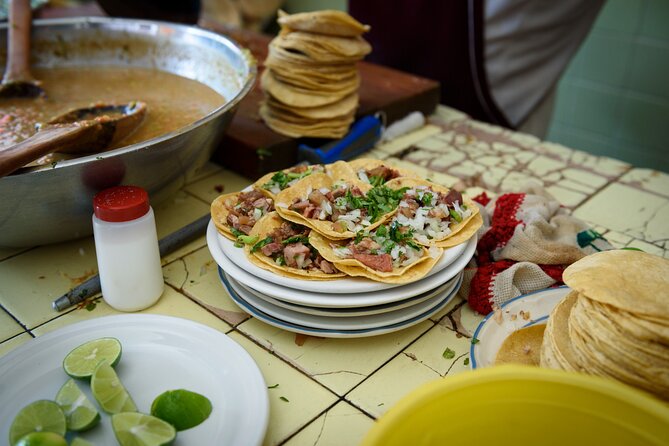
Later, the tour turns to succulent offal tacos. This is a more challenging stop for some people, but it is also one of the most revealing.
The tacos connect to slaughterhouses that once operated in the area. That link helps explain why certain foods became part of Azcapotzalco’s identity. Offal is not an exotic decoration here. It reflects a practical cooking tradition in which different parts of an animal were used and valued.
If you already enjoy tacos de lengua, tripa, or other offal dishes, you will likely welcome this stop. If you are unsure, you can approach it cautiously. Take a small bite first, listen to the guide’s explanation, and avoid feeling pressured to finish a portion that does not suit you.
This is also where the pacing becomes important. By now you have already had coffee, bread, eggs, enchiladas, and juice. The tacos may be delicious, but your appetite needs managing. Small portions and slow eating are sensible, especially if you are not used to rich food or unfamiliar ingredients.
The walk’s strongest teaching moments may come from these connections between food and work. The neighborhood is not presented as a backdrop for eating. Its former industries help explain what appeared on local plates.
A completely different day out, same corner of Mexico City:
- Teotihuacan pyramids morning or afternoon without tourist traps
★ 5.0 · 6,186 reviews - Teotihuacan Early Access Guided Tour with optional Lunch
★ 4.5 · 6,138 reviews - Balloon flight + pick up in CDMX + Breakfast in Cave + Pyramids
★ 5.0 · 5,651 reviews - Balloon Flight + Cave Breakfast + Pick Up from CDMX or We Fly
★ 5.0 · 4,410 reviews
Handmade tortillas and drinks with Aztec roots
The route then stops at an artisanal tortilleria. Fresh tortillas are a basic part of Mexican food, but seeing the craft behind them gives you a better sense of why they matter.
A tortilleria can look ordinary from the street, which is part of its appeal. This is not a grand attraction. It is a working food business, and the stop offers a look at an everyday product at its source. The details of texture, freshness, and preparation become easier to notice once you have eaten tortillas in many different settings.
After that, you visit a third-generation street stand for drinks whose roots reach back to Aztec times. The family history of the stand adds another layer. You are not only tasting an old beverage tradition, but also seeing how a family business can carry that tradition forward across generations.
The drink may be unfamiliar, and this is another point where a good guide adds real value. You can ask what it is made from, how it has changed, and how it fits into local life. The supplied information does not specify the drink, so you should not book expecting one particular beverage. Think of this as a chance to try something traditional that may not appear on a standard Mexico City food itinerary.
Ending in a 110-year-old Italian-Mexican cantina
The final food stop is a cantina opened about 110 years ago by a family from Italy. Here, you try the house cocktail and small dishes shaped by both Mexican traditions and the founders’ European background.
This is a smart ending because it widens the story again. Mexico City food is not a sealed tradition with no outside influence. Families arrive, settle, adapt, and add their own habits to local cooking. The cantina reflects that process in a very concrete way.
The cocktail gives the final stop a social feel, while the small dishes keep the focus on food. After the street tacos and traditional drinks, the cantina offers a different setting and a chance to slow down. You are still learning about Azcapotzalco, but the mood shifts from morning eating to an older style of neighborhood hospitality.
Alcohol is part of this stop, so keep that in mind when deciding how to pace yourself. The tour description does not state whether a nonalcoholic replacement is available, so ask when booking if that matters to you.
The cantina also helps explain why the tour lasts so long. Each stop has a distinct purpose. You are not spending six hours eating identical tacos. You are moving through breakfast, restaurant cooking, street food, tortilla production, traditional drinks, and cantina fare.
How much walking and food should you expect?
Plan on about six hours, even though the experience is also described in places as a five-hour food tour. The listed timing adds up to about six hours, with roughly an hour at the opening point, four hours in Azcapotzalco, and another hour for the final wrap-up.
The tour ends back at the starting point, so you do not need to arrange a separate pickup at the end. The meeting point is near public transportation, which helps, but the supplied details do not identify a specific metro or bus route. Check your route to Plaza de el Arbol de la Noche Triste before the morning of the tour.
You should wear comfortable shoes. The walk is not presented as a short tasting circuit, and one direct account describes lots of walking through new parts of Mexico City. That is a positive if you enjoy exploring on foot, but it may feel tiring if you expected to sit down for most of the day.
Bathroom access appears to be available at several points along the route. That is useful because the tour includes coffee, juice, traditional drinks, and a cocktail. Still, the exact facilities are not guaranteed at every stop, so plan sensibly.
Food safety and pacing advice
The tour operator says it works with vendors that follow strict food hygiene standards. That is reassuring, but no food experience can remove every risk. A direct account of the tour describes stomach trouble lasting several days after the meal, despite having spent nearly a week in Mexico City without problems.
That experience does not prove that any one dish caused the illness. It does show why pacing matters. You are eating many different foods in a short period, and your stomach may react to the quantity, unfamiliar ingredients, or simply bad luck.
Here is how I would approach the day:
- Eat a light breakfast or skip breakfast before the 10:00 a.m. start.
- Take small bites and small sips at every stop.
- Tell your guide if you have food restrictions or a sensitive stomach.
- Avoid scheduling this tour before a major travel day.
- Use the bathroom stops when available rather than waiting.
Most participants can take part, and service animals are allowed. The experience requires good weather, and poor weather can lead to a new date or a refund.
Is $140 a fair price?
At $140 per person, this is not a cheap way to grab lunch. You are paying for about six hours of guiding, a small group capped at seven, several tastings, and access to a side of Mexico City you might not find easily on your own.
The value depends on what you want. If you are looking for the lowest-cost way to eat tacos, this tour is too expensive. You could spend far less at street stands and local restaurants.
I think the price makes more sense if you value context and variety. The experience brings together a family-run restaurant, street tacos, a tortilleria, a third-generation drink stand, and a century-old cantina. Recreating that route independently would take research, time, and a willingness to get around an unfamiliar district without an English-speaking guide.
The small group also matters. With no more than seven people, you should have a better chance to hear explanations and ask about ingredients. That is more useful here than on a simple tasting tour because several stops involve food traditions that may not be obvious at first glance.
Who should book Azcapotzalco Culinary Kaleidoscope?
I would choose this tour if you enjoy walking, eating boldly, and learning how a neighborhood works through its food. It suits repeat visitors to Mexico City especially well, since Azcapotzalco offers a different experience from the city’s most familiar districts.
It also suits curious first-time visitors who want a guide to handle the route and explain what they are tasting. You should be comfortable with a long morning and afternoon, several servings, and dishes that may include offal or unfamiliar drinks.
I would hesitate if you need a gentle food schedule, dislike walking, or want complete control over every ingredient. The tour is also a poor choice immediately before a flight, bus ride, or other fixed commitment. Give yourself time afterward in case the food does not agree with you.
The tour receives a 4.8 rating, with 97 percent of participants recommending it. Those figures point to a strong overall experience, but they should not erase the one practical warning: this is a lot of food in a short span.
Should you book it?
Book Azcapotzalco Culinary Kaleidoscope if you want local food with a story, not a polished restaurant crawl. The best reasons are the small group, the unusual range of stops, the neighborhood setting, and the chance to connect dishes with Azcapotzalco’s working and family past.
Skip it if your stomach is fragile, your walking tolerance is low, or you prefer familiar Mexican dishes in moderate portions. For everyone else, this is one of the more distinctive ways to spend a full day eating in Mexico City, provided you pace yourself and arrive hungry but not overconfident.
FAQ
Where does the Azcapotzalco food tour begin?
The tour begins at Plaza de el Arbol de la Noche Triste in Popotla, Mexico City. The listed start time is 10:00 a.m.
Where does the tour end?
The experience ends back at the meeting point.
How long does the tour last?
Plan for approximately six hours. The experience is also described as a five-hour food tour, but the listed timing totals about six hours.
What food and drinks are included?
The route includes cafe de olla, sweet bread, huevos encamisados, enchiladas, freshly made juices, offal tacos, traditional drinks with Aztec roots, a house cocktail, and small cantina dishes.
Is the tour offered in English?
Yes. The activity is offered in English.
How large is the group?
The tour has a maximum of seven participants. Confirmation is usually provided when you book, subject to availability for bookings made within one day of the tour.
What is the cancellation policy?
You can cancel at least 24 hours before the start time for a full refund. Cancellations or changes made within 24 hours are not refunded or accepted. If poor weather or an unmet minimum causes cancellation, you will be offered another date or a full refund.
Just added around Mexico City
- Mexico City: Hop-on Hop-off City Tour by Turibus 2-Day Pass★ 4.0 · 10 reviews
- Anthropology Museum, Chapultepec Castle & Cable Car Tour★ 4.5 · 10 reviews
- Multi-Variety Mole Class in a Condesa home or art gallery rooftop★ 5.0 · 10 reviews
- PRIVATE TOUR Colonial Town Taxco and Cuernavaca from CDMX.★ 5.0 · 10 reviews
- El Centro Street Food Walking Tour★ 5.0 · 10 reviews
- Private Round-Trip Transportation to Teotihuacan Pyramids★ 5.0 · 10 reviews
- Teotihuacan and My Grandma’s Food Tour★ 5.0 · 10 reviews
- Private Walking Tour Legends and Events Historic Center CDMX★ 4.8 · 10 reviews