
Reviewed · MEXICO CITY
Ciudad de Mexico: Historia y vida moderna en la capital
Mexico City reveals its past in layers. On this walk, you can look from the Aztec ruins of Templo Mayor to the Metropolitan Cathedral, then continue toward grand palaces, old hospitals, and working city streets. It is a useful way to see how Mexico City grew from Tenochtitlan into the capital you visit today.
I like two things here. First, the route mixes famous sights with less obvious stops such as Hospital de Jesús and Plaza de Santo Domingo. Second, the guide connects architecture, food, art, and present-day life rather than treating history as a list of dates. The main consideration is the pace: three and a half hours on foot, with several stops and only one planned refreshment break, calls for good shoes and water.
In This Review
- Key points at a glance
- Why this is a smart first-day walk
- Starting at Hospital de Jesús on Pino Suárez
- The Zócalo and Metropolitan Cathedral
- Santo Domingo and the Aztec remains
- A refreshment break at Plaza Manuel Tolsá
- Casa de los Azulejos and the city’s grand palaces
- Finishing at the Palace of Fine Arts
- What the $37 price really gives you
- Walking comfort, language, and flexibility
- Who will get the most from this walk
- Should you book Ciudad de Mexico: Historia y vida moderna en la capital?
- FAQ
- How long does the Mexico City history and modern life tour last?
- What language is the tour offered in?
- Where is the meeting point?
- What places are visited?
- Is food included?
- Are museum entrances included?
- Is the tour wheelchair accessible?
- Can I cancel the booking?
Key points at a glance
- Aztec and colonial history meet at Templo Mayor and the Cathedral, two of the most important sights in the Centro Histórico.
- Hospital de Jesús gives the tour an unusual starting point, taking you to one of the oldest buildings along Pino Suárez.
- Martin leads the experience in English or Spanish, and Regina has also guided the walk when needed.
- A small group of up to 10 people gives you more room to ask questions and follow the guide’s explanations.
- A fresh juice or typical Mexican snack is included, with time to pause at Plaza Manuel Tolsá.
- The route ends near Bellas Artes, after stops at the Casa de los Azulejos and Palacio de Correos.
Why this is a smart first-day walk
I would put this tour near the start of a Mexico City visit because it gives you a working map of the historic center. You pass major sights you may want to revisit later, while also learning about places to eat and shop during the rest of your stay.
The route is built around walking, not transport. That matters in the Centro Histórico, where the relationship between one building and the next is part of the story. A former hospital, a public square, a church, an Aztec temple, and a grand post office make more sense when you see them in sequence.
The guide also covers several subjects at once. You hear about architecture, food, art, anthropology, the pre-Hispanic period, and modern city life. That wider view is valuable if you want more than a quick photo tour.
Martin is the named guide, and he leads in English and Spanish. The experience has also been guided by Regina, who is described as flexible and able to adjust the walk to the group. That personal approach is a plus for anyone who prefers conversation over a fixed speech.
Other Mexico City days people book alongside this one:
- Teotihuacan, Guadalupe Shrine & Tlatelolco Day Tour with Lunch
★ 5.0 · 11,603 reviews - Xochimilco, Coyoacan and Frida Kahlo with Optional Lunch
★ 4.5 · 7,320 reviews - Balloon flight + Breakfast in cave + Pyramids + Pick up CDMX.
★ 5.0 · 6,335 reviews
Starting at Hospital de Jesús on Pino Suárez
Meet in the square in front of the Museo de la Ciudad de México, at Rcda. de Jesús 548. The first stop is Hospital de Jesús Nazareno, where you spend about 20 minutes with the guide.
This is a strong opening because it moves you away from the most obvious postcard sights. The hospital is tied to the earliest colonial period of Mexico City, and its location helps explain how the new city was built over the old one.
You are not simply looking at an old facade. The guide uses the building to begin the story of the neighborhood, from the pre-Hispanic era through the colonial period and into the present. That approach gives context before you reach the Zócalo.
The Museo de la Ciudad de México follows, with about 10 minutes of guided attention. The short stop means you should not expect a full museum visit. Instead, it works as a brief introduction to the city’s cultural and urban development.
If you like spending a long time inside museums, this portion may feel quick. If you want a broad orientation before exploring on your own, the timing is sensible.
The Zócalo and Metropolitan Cathedral
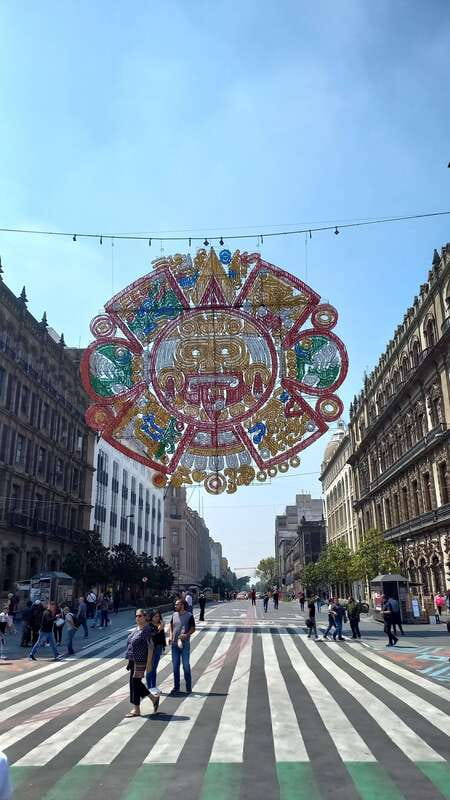
After about 10 minutes on foot, the group reaches the Zócalo, Mexico City’s central square. The tour allows roughly 30 minutes for a photo stop and explanation.
The Zócalo is where the city’s different eras come together most clearly. You can feel the scale of the capital here, but the guide’s job is to help you read the square rather than simply photograph it. Expect discussion of the historical forces that shaped the center and the role it still plays in city life.
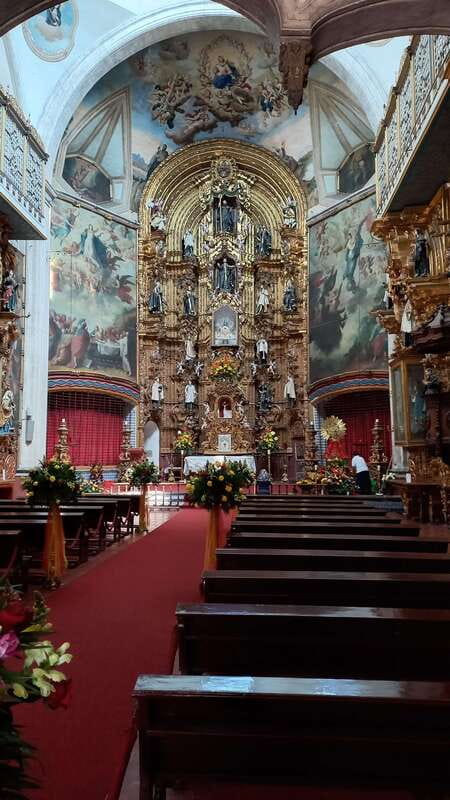
Next comes the Metropolitan Cathedral, with about 30 minutes for a visit, photos, and guided commentary. This is one of the route’s major stops, and rightly so. Its position near Templo Mayor makes the city’s changing religious and political order visible in a single stretch of pavement.
The cathedral portion is especially useful if you want help noticing details in the building. Architecture can seem overwhelming when you look at a large church without context. A guide trained in art and history can point out what matters and explain how the structure fits into Mexico City’s story.
The route does not promise a long, specialized cathedral lecture. Think of it as a focused visit that leaves you with time to keep walking. That balance suits a first-day introduction, though anyone wanting an extended church tour may want to return independently.
Santo Domingo and the Aztec remains
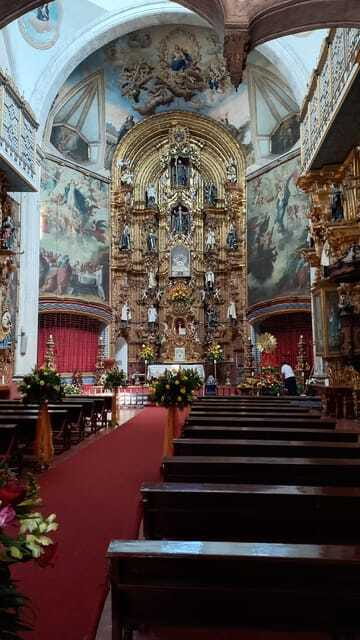
A 15-minute walk leads to Plaza de Santo Domingo. You spend about 20 minutes here with a photo stop and guided explanation.
This square adds another layer to the center’s story. It is a good place to slow down and consider how public spaces change purpose over time. The guide discusses the surrounding buildings and the neighborhood’s history, linking the architecture to daily life.
From here, it is only about five minutes on foot to Templo Mayor de México-Tenochtitlan. This is one of the most important stops on the route, with approximately 20 minutes for photos and interpretation.
The Aztec remains are not an isolated archaeological site far from the modern city. They sit beside the colonial center, close to the cathedral and major government buildings. That physical closeness is the point. You can see how Mexico City was built in layers, with the remains of Tenochtitlan still present beneath and beside later construction.
The 20-minute visit is enough for orientation and key explanations, but not for a full museum session. Some museum admission is not included, so check what you want to see before booking. If your main goal is to study every artifact, plan separate time for the museum. If you want the ruins placed in the wider story of the city, the guided stop should do that.
A completely different day out, same corner of Mexico City:
- Teotihuacan pyramids morning or afternoon without tourist traps
★ 5.0 · 6,186 reviews - Teotihuacan Early Access Guided Tour with optional Lunch
★ 4.5 · 6,138 reviews - Balloon flight + pick up in CDMX + Breakfast in Cave + Pyramids
★ 5.0 · 5,651 reviews - Balloon Flight + Cave Breakfast + Pick Up from CDMX or We Fly
★ 5.0 · 4,410 reviews
A refreshment break at Plaza Manuel Tolsá
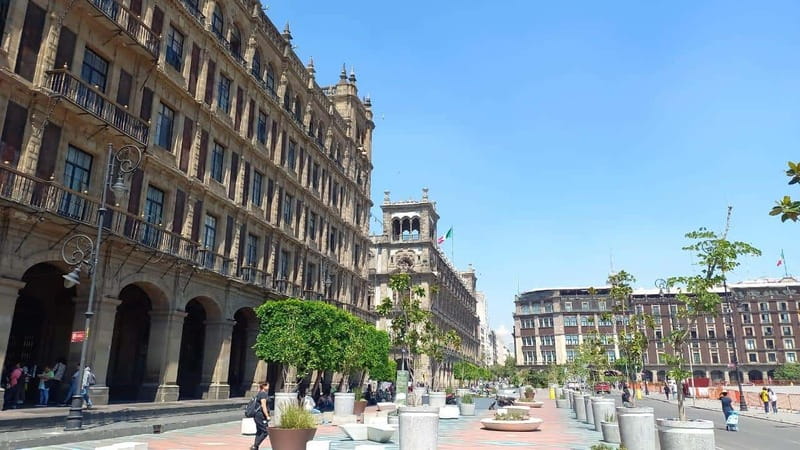
After another 15 minutes of walking, the group reaches Plaza Manuel Tolsá for a 30-minute break and food tasting.
This pause is well placed. By this point, you have covered major historical material and walked through several busy parts of the center. A fresh juice or a typical Mexican snack gives you a chance to rest while trying a local flavor.
The included tasting is modest, not a full meal. If you want more food, you pay for it yourself. That is worth keeping in mind because the tour lasts three and a half hours and includes plenty of walking.
The break also adds a practical side to the experience. The guide can point out food options for later, and you can ask questions about dishes, neighborhoods, and what to try during your stay. One guide, Regina, has been described as taking the group to coffee and enchiladas when circumstances allowed, but you should treat that as a personal adjustment rather than a guaranteed part of the schedule.
Bring water even though refreshments are included. Mexico City weather can change, and the advice to check the forecast is sensible.
Casa de los Azulejos and the city’s grand palaces
The route continues on foot for about 10 minutes to the Casa de los Azulejos. You spend around 10 minutes here for photos, a visit, and guided commentary.
The building is known for its tiled exterior, which gives the stop a strong visual change after the archaeological and religious sites. It also shows how the historic center is not made up only of temples and government buildings. Former private and commercial spaces are part of the city’s architectural character too.
The short visit works best as an exterior-focused stop with a few key details. You should not expect an hour inside. It is a useful pause for photography and for understanding how decorative design fits into the larger history of the center.
The next segment includes a 10-minute walk near Jugos Canada. The information provided does not describe this as a formal guided stop, so consider it part of the route rather than a major attraction. It reinforces the everyday side of downtown, where food and drink shops sit close to landmark buildings.
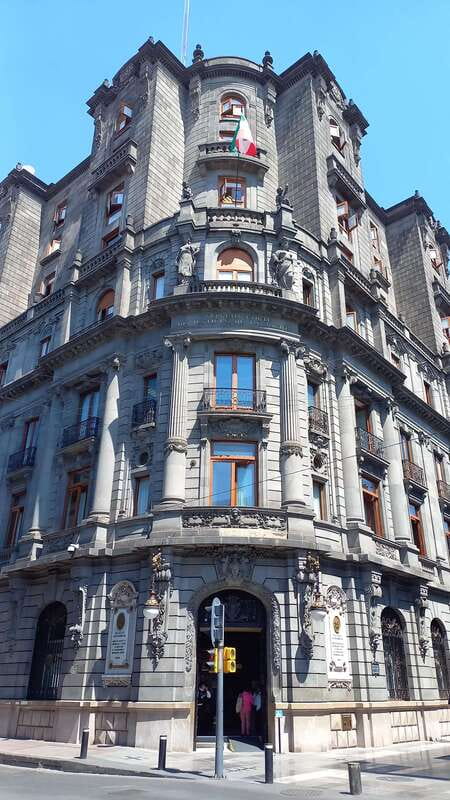
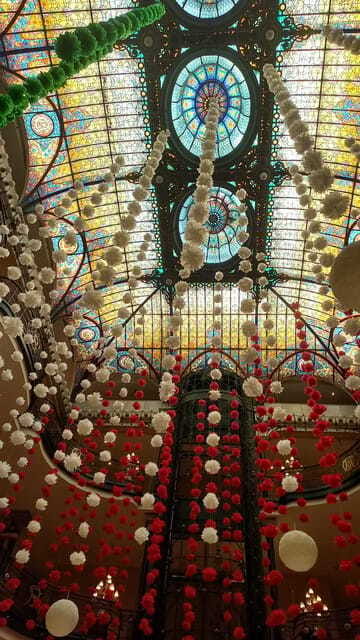
You then reach the Palacio de Correos de México for about 15 minutes of photos, a visit, and guided explanation. This is one of the city’s most ornate civic buildings, and the stop helps balance the earlier focus on ancient and religious history.
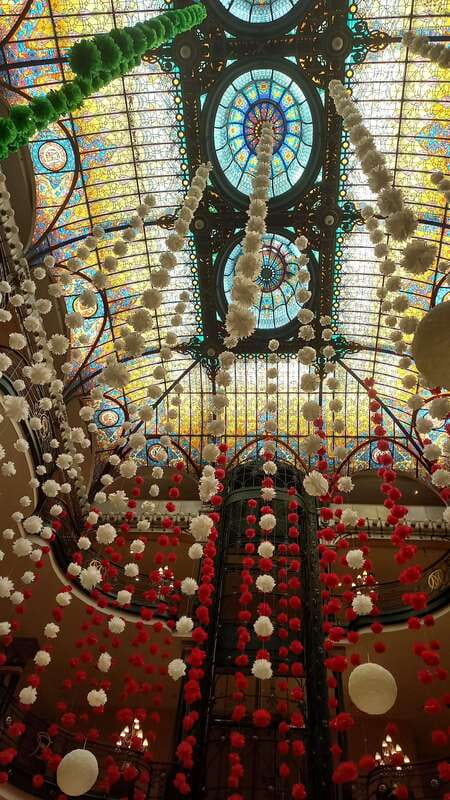
The post office is a reminder that Mexico City’s history continued long after the colonial period. Its grand interior and decorative details show the ambition of a modernizing capital. With a guide, you can connect the building’s appearance to the city’s changing public life rather than treating it as just another pretty facade.
Finishing at the Palace of Fine Arts
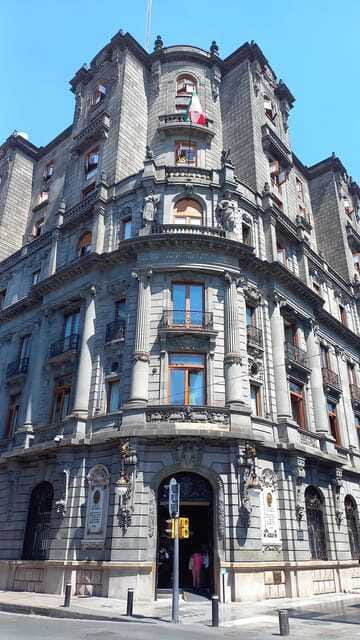
The final major stop is the Palace of Fine Arts, with about 15 minutes for photos, a visit, and commentary. The tour finishes nearby at CVP4+9C Ciudad de México.
Bellas Artes gives the walk a fitting endpoint because it brings art and modern national identity into the story. Earlier stops focus heavily on ancient remains, colonial buildings, and religious power. Here, the emphasis shifts toward performance, visual art, and the cultural image of Mexico City.
Fifteen minutes is enough to understand why the palace matters and to take in its exterior and nearby setting. It is not enough for a full museum visit or a detailed look at every collection. If you want to see the inside galleries, plan another visit and remember that some museum entrances are not included.
Ending near Bellas Artes is convenient. You are left close to one of the capital’s best-known cultural areas, with the rest of the historic center still within reach. The walk gives you ideas for what to explore next instead of trying to cover every room in every building.
What the $37 price really gives you
At $37 per person, this is priced as an affordable guided introduction rather than a premium private tour. You are paying for three and a half hours of expert guidance, several historical-building visits, access to churches and historical temples where applicable, and one traditional drink or snack.
The value comes from the range. In one morning or afternoon, you cover Hospital de Jesús, the city museum, the Zócalo, the cathedral, Santo Domingo, Templo Mayor, Plaza Manuel Tolsá, Casa de los Azulejos, Palacio de Correos, and Bellas Artes. Seeing all of these independently would require planning, route-finding, and research.
The tradeoff is depth. Most stops last 10 to 30 minutes, so the tour gives you a strong framework rather than a specialist study of each site. Extra museum food or admission costs are not included.
The group is limited to 10 people, which is a useful middle ground. You get a social walk without the feel of a large crowd, and you should have a fair chance to ask questions. The exact starting time depends on availability.
Walking comfort, language, and flexibility
Wear comfortable shoes. The route includes several walking stretches of 5, 10, and 15 minutes, plus time standing at outdoor sites and inside buildings. You should also bring water and check the weather before leaving.
The tour is offered in English or Spanish. That makes it practical for mixed-language couples and small groups, but confirm your preferred language when booking.
The experience is listed as wheelchair accessible. Even so, the route includes public squares, historic buildings, sidewalks, and archaeological areas, so it is sensible to confirm any specific mobility needs in advance.
Free cancellation is available up to 24 hours before the activity for a full refund. You can also reserve and pay later, which helps if your first days in Mexico City are still changing.
Who will get the most from this walk
I would recommend it to a first-time visitor who wants historical context before choosing which museums and neighborhoods deserve more time. It also suits anyone who likes architecture, food, and city life presented together.
It is a good fit for people who enjoy walking and asking questions. The small group and live guide make the experience more personal than simply following a printed route.
Families and mixed-interest groups may also find the variety useful. Ancient ruins, grand churches, colorful tiles, public squares, food, and art give the walk several entry points.
I would be more cautious if you want long museum visits, a slow photographic pace, or a specialized archaeological tour. The schedule moves steadily, and the main goal is to connect many parts of the historic center in one outing.
Should you book Ciudad de Mexico: Historia y vida moderna en la capital?
Book it if you want to get your bearings fast and understand why Mexico City looks the way it does. The strongest features are the route’s historical range, the unusual opening at Hospital de Jesús, the close pairing of Templo Mayor and the cathedral, and the chance to ask questions in a group of no more than 10.
The $37 cost is fair for a three-and-a-half-hour introduction with a guide, building visits, and a small food tasting. Just bring water, wear good shoes, and save extra time for any museum you want to explore in detail.
If you have only one day in the historic center, this walk gives you a useful foundation. If you already know the area well, choose it only if you want a fresh explanation of the city’s history and modern culture from Martin or Regina.
FAQ
How long does the Mexico City history and modern life tour last?
The tour lasts 3.5 hours.
What language is the tour offered in?
The live guide offers the tour in English and Spanish.
Where is the meeting point?
Meet in the square in front of the Museo de la Ciudad de México, at Rcda. de Jesús 548.
What places are visited?
The route includes Hospital de Jesús Nazareno, Museo de la Ciudad de México, the Zócalo, Metropolitan Cathedral, Plaza de Santo Domingo, Templo Mayor, Plaza Manuel Tolsá, Casa de los Azulejos, Palacio de Correos, and the Palace of Fine Arts.
Is food included?
A traditional fresh juice or a taste of a typical Mexican snack is included. Any extra food is at your own expense.
Are museum entrances included?
Entrance is offered for museums, churches, historical temples, and historical buildings included in the experience, but admission to some museums is not included.
Is the tour wheelchair accessible?
Yes, the activity is listed as wheelchair accessible.
Can I cancel the booking?
Yes. You can cancel up to 24 hours in advance for a full refund. Reserve now and pay later is also available.
Just added around Mexico City
- Mexico City: Hop-on Hop-off City Tour by Turibus 2-Day Pass★ 4.0 · 10 reviews
- Anthropology Museum, Chapultepec Castle & Cable Car Tour★ 4.5 · 10 reviews
- Multi-Variety Mole Class in a Condesa home or art gallery rooftop★ 5.0 · 10 reviews
- PRIVATE TOUR Colonial Town Taxco and Cuernavaca from CDMX.★ 5.0 · 10 reviews
- Private Round-Trip Transportation to Teotihuacan Pyramids★ 5.0 · 10 reviews
- Teotihuacan and My Grandma’s Food Tour★ 5.0 · 10 reviews
- El Centro Street Food Walking Tour★ 5.0 · 10 reviews
- Private Walking Tour Legends and Events Historic Center CDMX★ 4.8 · 10 reviews