
Reviewed · MEXICO CITY
Fly over to the Unexplored Parts of CDMX by Cable Car
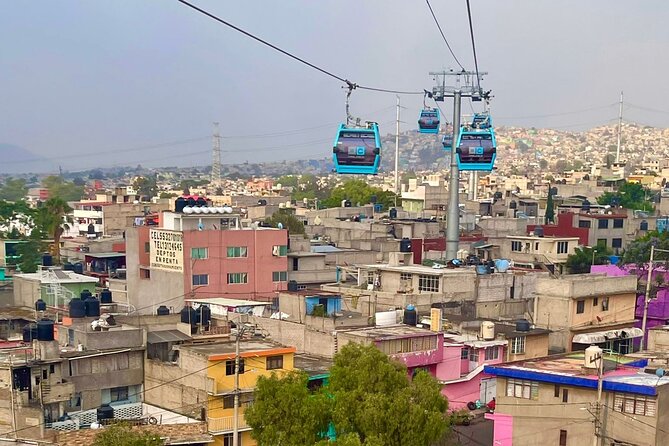
Mexico City’s Cablebús is not a theme-park ride. It is working public transit, carrying you above the dense neighborhoods of Iztapalapa while rooftops, murals, streets, and the city’s huge scale unfold below. This tour uses that ride as a doorway into a part of CDMX most first-time visitors never reach.
I like two things especially: Fernando’s energetic explanations connect Mexico City’s history, transport system, and present-day life, and the route gives you real local food, striking murals, and a traditional pulque tasting rather than another parade of famous monuments. The main drawback is the pace. You should expect plenty of walking, stairs, noisy public transport, and little time to linger.
In This Review
- At a glance
- Why this tour takes you beyond postcard Mexico City
- Starting at Churrería El Moro in Centro
- Museum of Cultures by Iztapalapa Passion
- Walking through Iztapalapa
- Mercado Quetzalcóatl: tacos and large-scale murals
- The Cablebús ride above Iztapalapa
- Pulque at a local bar
- What the $58 price buys you
- Who should book, and who should pause
- My take on the four-and-a-half-hour route
- FAQ
- How long does the Cablebús and Iztapalapa tour last?
- Where does the tour start?
- Where does the tour finish?
- Is the tour offered in English?
- What is included at the market?
- Is a museum admission included?
- Does the tour include a drink?
- What happens if I need to cancel?
At a glance
- Ride the Cablebús as local transit: See Iztapalapa from above while learning how CDMX’s public transport works.
- Explore the city’s largest district: Walk through streets and a cultural center far from the standard Centro Histórico circuit.
- Visit the Museum of Cultures by Iztapalapa Passion: Get a short introduction to local traditions and the area’s past.
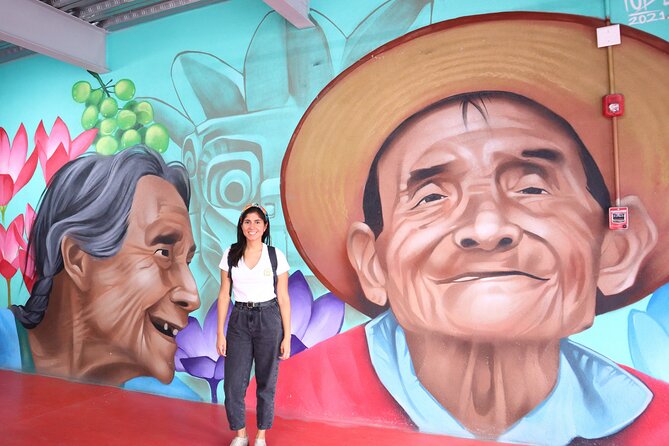
- Eat at Mercado Quetzalcóatl: Sample tacos and see murals that turn an ordinary market stop into a visual highlight.
- Finish with pulque: Try a pre-Hispanic alcoholic drink at a local bar in or near the historic center.
- Plan for an active half-day: The group can reach 20 people, and the outing moves quickly through Metro stations, streets, and Cablebús stops.
Why this tour takes you beyond postcard Mexico City
Most first visits to Mexico City stay near Centro Histórico, Roma, Condesa, Chapultepec, Coyoacán, and the major museums. Those areas deserve your time, but they do not explain the full size or social range of the capital.
I like this experience because it takes you into Iztapalapa without asking you to plan a complicated route on your own. You use public transportation, walk through local streets, stop for food, and ride high above the district. The result is not a polished sightseeing loop. It is a practical look at how a large part of the city functions.
Fernando is the central personality of the day. His style is fast, direct, and packed with information. He covers the city’s history, geography, transit network, and the communities along the route. His sister Alex has also helped lead the outing, and the team’s approach is clearly personal rather than scripted.
The public transport lesson has real value. If you are new to the Mexico City Metro, this gives you a guided first try. You learn how the system fits together while moving toward the Cablebús, rather than sitting in a vehicle separated from daily city life.
There is also a useful timing advantage. This is a good tour early in your stay because the transit orientation can help you use the Metro and other public systems during the rest of your visit. Fernando also gives food and bar suggestions for later in your trip.
Other Mexico City days people book alongside this one:
- Teotihuacan, Guadalupe Shrine & Tlatelolco Day Tour with Lunch
★ 5.0 · 11,603 reviews - Xochimilco, Coyoacan and Frida Kahlo with Optional Lunch
★ 4.5 · 7,320 reviews - Balloon flight + Breakfast in cave + Pyramids + Pick up CDMX.
★ 5.0 · 6,335 reviews
Starting at Churrería El Moro in Centro
The meeting point is Churrería El Moro Centro, at Eje Central Lázaro Cárdenas 42 in Centro Histórico. Starting here places you in a familiar central zone before the route heads toward less familiar parts of CDMX.
The activity is offered in English and uses a mobile ticket. Confirmation arrives at booking, and the group can include up to 20 people. That is small enough for a guide to keep the group together, though a full group may feel crowded on sidewalks, in stations, and around food stops.
The published duration is about four hours and 30 minutes. That sounds generous, but the route covers several locations and includes public transport, so the time goes quickly. I would avoid scheduling a major museum booking or airport transfer immediately afterward.
The meeting point is near public transportation, which fits the nature of the outing. Wear shoes suited to walking and stairs. One of the clearest practical lessons from the day is that this is not a ride where you sit back for four hours.
Museum of Cultures by Iztapalapa Passion
The first stop is the Museum of Cultures by Iztapalapa Passion, with about 35 minutes inside and admission included. The museum explains the history and traditions of Iztapalapa, giving you context before you walk through the district.
This short visit matters because Iztapalapa is not just a distant place on the map. It has its own traditions, local identity, and cultural life. A brief museum introduction helps you read the streets and murals that follow with more understanding.
Do not expect a long, leisurely museum session. Thirty-five minutes is enough for an orientation, not for a close study of every display. I see that as a fair trade on a route with so much ground to cover, but museum lovers may wish the stop were longer.
Fernando’s commentary is especially useful here. His explanations tie the local material to wider questions about Mexico City, including how the capital grew and how different districts developed. The museum works best as the opening chapter rather than the main attraction.
Walking through Iztapalapa
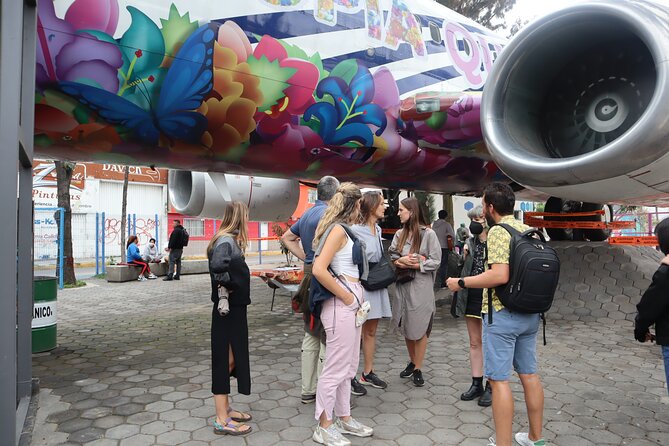
The next section takes about an hour and includes a walk through Iztapalapa, a visit to a cultural center, local food, and the approach to the Cablebús. This is where the outing becomes most different from a standard city tour.
You walk through streets where daily life is the subject. There is no expectation that every corner will be arranged for sightseeing, and that is part of the point. Iztapalapa is a working district, not a staged attraction.
The tour presents the area through history and current life. Fernando explains what you are seeing and gives the district a wider place in the story of CDMX. That interpretation is important because simply passing through an unfamiliar neighborhood would not provide the same value.
This is also one of the most demanding parts physically. You may move between streets, stations, and cultural sites at a quick pace. Several people have found the activity fast and interactive, which suits active walkers but may frustrate anyone who needs frequent rests.
If you use a cane, have hearing difficulty, or struggle with rapid English, think carefully before booking. One detailed account raised concerns about the guide’s communication style and the speed of the walking and explanations. Most of the available feedback is strongly positive, but this experience is not designed around a slow or highly flexible pace.
A completely different day out, same corner of Mexico City:
- Teotihuacan pyramids morning or afternoon without tourist traps
★ 5.0 · 6,186 reviews - Teotihuacan Early Access Guided Tour with optional Lunch
★ 4.5 · 6,138 reviews - Balloon flight + pick up in CDMX + Breakfast in Cave + Pyramids
★ 5.0 · 5,651 reviews - Balloon Flight + Cave Breakfast + Pick Up from CDMX or We Fly
★ 5.0 · 4,410 reviews
Mercado Quetzalcóatl: tacos and large-scale murals
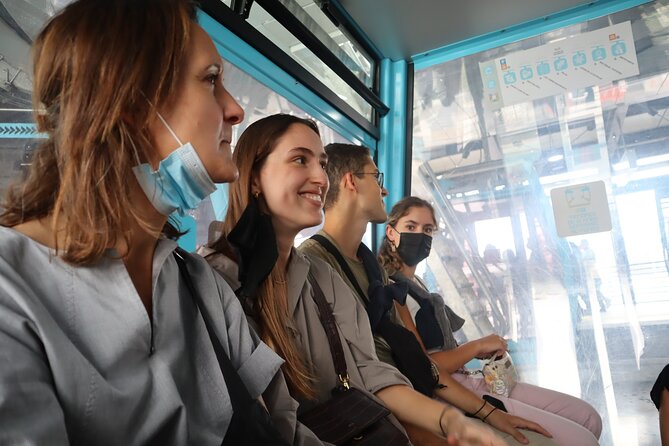
Mercado Quetzalcóatl gets about 30 minutes. The stop includes tacos and murals, making it one of the tour’s strongest combinations of food and local art.
The market food is a practical pleasure. You are not just hearing about what people eat in the district, you get a chance to try it. Carnitas have been singled out as especially good, and the taco stop gives the outing a welcome break from transit and walking.
The murals may be the visual surprise. They appear on market and neighborhood surfaces rather than inside a major art museum. Some are large and colorful, and Fernando helps explain what you are looking at instead of leaving you to take a quick photograph and move on.
Thirty minutes is a short market visit. You should not expect a long meal or a chance to explore every aisle. Think of it as a focused food and art stop within a larger route.
This is one reason I find the tour better suited to curious people than to checklist sightseeing. The market, murals, and streets provide a sense of place that a quick visit to a famous plaza cannot provide on its own.
The Cablebús ride above Iztapalapa
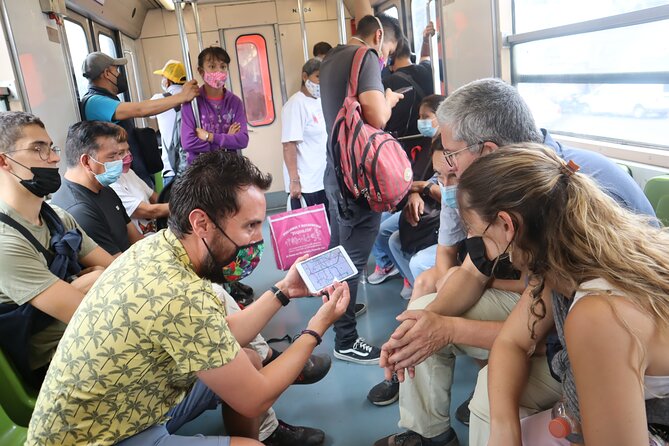
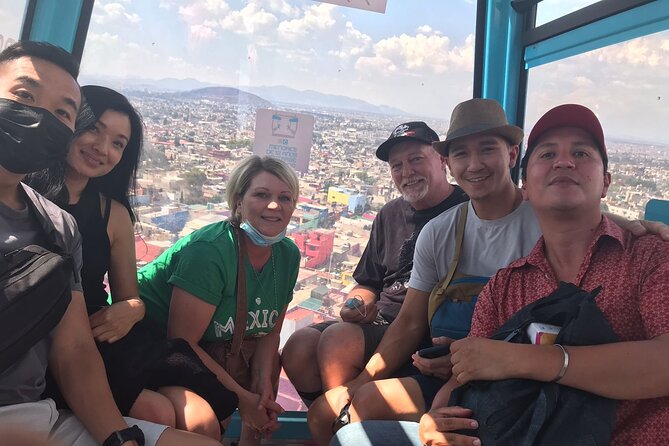
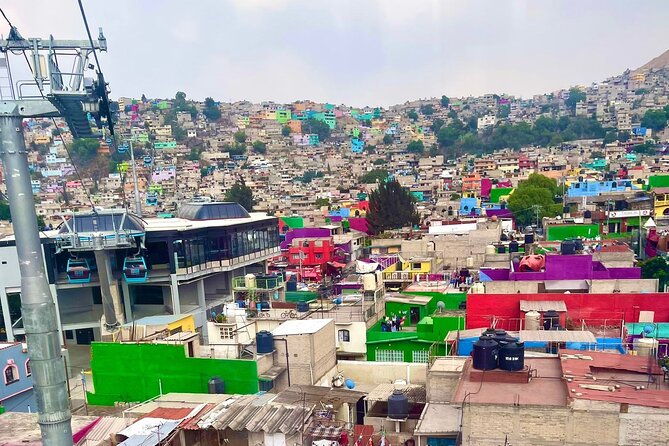
The Cablebús is the headline experience, and it earns that billing. From the cabins, you see the density of the neighborhoods from a new angle, with homes, streets, rooftops, murals, and distant volcanic forms spreading across the view.
The ride itself is smooth and functions as everyday transportation. That makes the experience more revealing than a purpose-built sightseeing cable car. You are seeing a transport solution used by residents while gaining a clear sense of how enormous Mexico City is.
I like the way the elevated route changes your understanding of distance. On street level, blocks and hills can feel disconnected. From above, the pattern becomes clearer. The ride shows how communities fit together and how far the capital extends beyond the central districts.
The rooftops and painted buildings are another highlight. From the cabin, murals can take on a different scale, and details that might be easy to miss from the street become part of the view. Fernando’s commentary adds meaning to what you see below.
Safety is a natural concern when an activity takes you into an unfamiliar part of a huge city. The ride is described as smooth and safe, and its role as public transit is reassuring. Still, this is not a private vehicle experience, so you should be ready to follow the guide through stations and boardings.
Pulque at a local bar
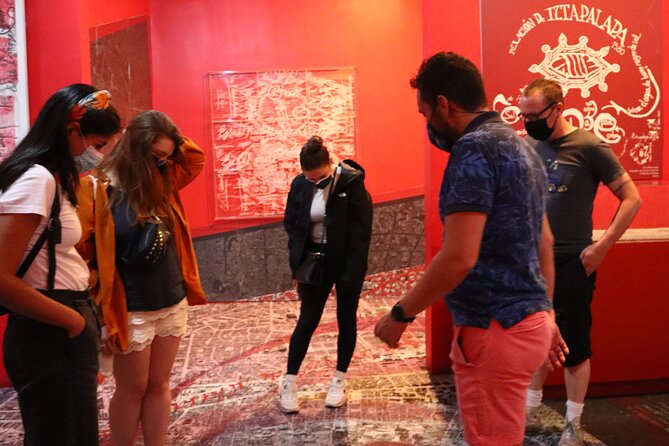
The published route finishes with a drink at a local pulquería, where you try pulque, a traditional pre-Hispanic alcoholic beverage. The itinerary names Pulquería Vacas Verdes Bellas Artes, while the stated end point is Pulquería La Risa on Calle de Mesones 71 in Centro Histórico. Since those details do not fully match, confirm the final bar location when you book or meet the guide.
Pulque gives the day a fitting ending. After seeing modern transport and present-day neighborhoods, you taste a drink tied to older Mexican traditions. It is a small but meaningful bridge between the city’s past and its current social life.
The bar stop is listed at about 20 minutes, so this is a tasting rather than a long evening out. The price includes an alcoholic beverage and a complimentary snack, according to the tour details. If you do not drink alcohol, ask the operator what nonalcoholic option is available before setting out, since no specific substitute is stated.
The final stop also returns you toward the historic center, which is convenient if you want to continue sightseeing or find dinner nearby. The exact end point should be checked because the supplied meeting information gives two different bar names.
What the $58 price buys you
At $58 per person, I consider this a strong value if you want more than a sightseeing ride. The price covers the guide, included museum admissions, market food, a snack, an alcoholic beverage, and the organization needed to connect several public transport segments.
The transport instruction is a major part of the value. You are not paying simply to be carried to Iztapalapa and back. You are learning how to use one of the city’s most useful systems while gaining a guide’s explanation of the places along the way.
The experience also covers ground that can be difficult to plan independently, especially if you are unfamiliar with CDMX transit or do not speak much Spanish. The food and drink make the price feel less abstract, but the real value is the access and context.
There are limits. This is not a private tour, and a group of 20 may not receive the same personal attention as a smaller outing. The schedule is tightly packed, and the food portions or drink experience should not be mistaken for a full meal or bar crawl.
I would compare it with the cost of arranging several separate activities. A museum visit, a market outing, a Cablebús ride, and a transit lesson would take more planning and would not necessarily produce the same connected story. For an active first or second day in CDMX, the price is reasonable.
Who should book, and who should pause
I would recommend this tour to you if you want to see beyond the usual tourist districts, enjoy public transportation, and like having history explained while you move. It is also a smart choice for families with older children and teenagers who may find the Cablebús and market more engaging than a long formal museum visit.
The activity suits people who want a local neighborhood experience without wandering into an unfamiliar district alone. You get a guide, a defined route, and a chance to ask questions along the way.
I would pause if you walk slowly, need a relaxed schedule, or find rapid English difficult to follow. The guide speaks fluent English, but one detailed complaint describes the delivery as very fast, especially in noisy Metro settings.
You should also consider the weather. The activity requires good conditions and may be moved or refunded if poor weather causes cancellation. Free cancellation is available up to 24 hours before the start time, but changes or cancellations within 24 hours are not refunded.
My take on the four-and-a-half-hour route
I like this experience because it treats Mexico City as a living city rather than a collection of central attractions. The Cablebús gives you the memorable view, but the museum, streets, market, tacos, and pulque are what make the day feel complete.
Fernando’s strongest quality is his passion for the city and for Iztapalapa. His explanations cover much more than the cable car, and his advice about public transit, food, and bars can help shape the rest of your stay.
The tour is not polished in the quiet, slow-moving sense. It is active, fast, and sometimes demanding. That honesty matters. If you want a gentle half-day with long stops and plenty of free time, choose something else.
If you want a sharp introduction to CDMX’s size, transit system, local food, and less visited neighborhoods, I think you should book it. Go early in your visit, wear comfortable shoes, keep your schedule open afterward, and confirm the final pulquería location before the day begins.
FAQ
How long does the Cablebús and Iztapalapa tour last?
The experience lasts about four hours and 30 minutes.
Where does the tour start?
It starts at Churrería El Moro Centro, Eje Central Lázaro Cárdenas 42, Centro Histórico, Mexico City.
Where does the tour finish?
The stated end point is Pulquería La Risa at Calle de Mesones 71 in Centro Histórico. The itinerary also names Pulquería Vacas Verdes Bellas Artes, so confirm the exact final bar location with the operator.
Is the tour offered in English?
Yes. The activity is offered in English.
What is included at the market?
The Mercado Quetzalcóatl visit includes tacos and access to see the murals.
Is a museum admission included?
Yes. Admission to the Museum of Cultures by Iztapalapa Passion is included.
Does the tour include a drink?
Yes. The experience includes an alcoholic beverage and finishes at a local bar with a traditional pulque tasting.
What happens if I need to cancel?
You can cancel at least 24 hours before the start time for a full refund. Cancellations or changes made less than 24 hours before the start time are not refunded. If poor weather or an insufficient number of bookings cancels the activity, you are offered another date or experience, or a full refund.
Just added around Mexico City
- Mexico City: Hop-on Hop-off City Tour by Turibus 2-Day Pass★ 4.0 · 10 reviews
- Anthropology Museum, Chapultepec Castle & Cable Car Tour★ 4.5 · 10 reviews
- Multi-Variety Mole Class in a Condesa home or art gallery rooftop★ 5.0 · 10 reviews
- PRIVATE TOUR Colonial Town Taxco and Cuernavaca from CDMX.★ 5.0 · 10 reviews
- El Centro Street Food Walking Tour★ 5.0 · 10 reviews
- Private Round-Trip Transportation to Teotihuacan Pyramids★ 5.0 · 10 reviews
- Teotihuacan and My Grandma’s Food Tour★ 5.0 · 10 reviews
- Private Walking Tour Legends and Events Historic Center CDMX★ 4.8 · 10 reviews