
Reviewed · MEXICAN COOKING CLASSES
Learn to Cook Mexican Salsas
At this Mexico City cooking class, salsa is not a side dish. It is the main lesson, the market guide, and the excuse to sit down together over hot quesadillas. You start at the ancient San Gabriel Arcángel Church in Tacuba, shop for ingredients in the local market, then walk five minutes to a home kitchen for four distinct preparations.
I especially like the market visit, where you help choose the produce rather than arriving to find every ingredient measured out. I also like the clear cooking structure: one salsa is raw, one fried, one boiled, and one roasted. The main consideration is spice. The class adapts to different tolerances, but you should still be comfortable tasting chiles and spending time in a working neighborhood rather than a polished culinary studio.
In This Review
- Key points to know before booking
- Starting at San Gabriel Arcángel Church in Tacuba
- Choosing ingredients at Tacuba Market
- Four salsas, four different personalities
- Quesadillas turn the lesson into lunch
- Meeting the hosts in a home kitchen
- What the price includes at $96
- Who will enjoy this most
- Small details that make the experience memorable
- Cancellation and booking notes
- Should you book the Tacuba salsa class?
- FAQ
- Where does the salsa class meet?
- Where does the activity end?
- How long does the experience last?
- How much does the experience cost?
- Is transportation included?
- What languages are offered?
- How many people participate?
- What food is included?
- Is there a vegan option?
- Can I cancel for a refund?
Key points to know before booking
- Four cooking methods: Prepare raw, fried, boiled, and roasted salsas, each with a different taste and texture.
- Tacuba Market shopping: Select fresh produce, spices, and other ingredients with your host before cooking.
- Home-style setting: The class takes place about five minutes on foot from the market, in the host’s home.
- A full snack-sized meal: Totopos, salsa, quesadillas with Oaxaca cheese, and unlimited jamaica water are included.
- Useful souvenirs: Take home a jar of salsa and recipe cards so the class can continue in your own kitchen.
- Private group format: Only your group participates, with English offered and other languages possible by arrangement.
Starting at San Gabriel Arcángel Church in Tacuba
Your meeting point is Parroquia San Gabriel Arcángel, on Calzada México-Tacuba in Miguel Hidalgo. This is a useful start because it puts you in an established local neighborhood before the food work begins. The church has roots reaching back before the Spanish arrived in the Americas, giving the opening a little historical weight without turning the class into a formal history tour.
Look for the exact church address, Calz México-Tacuba S/N, Tacuba, rather than simply heading toward a general market area. The activity ends back at the meeting point, so you are not left trying to find your way from an unfamiliar residential street after the class.
The location is near public transportation. Private transportation is not included, so you will need to make your own way to Tacuba. Since the class lasts about two and a half hours, it fits well into a morning or afternoon plan, but allow extra time for getting across Mexico City.
More Mexican cooking classes:
- Mexican Cooking Class with Food Market Visit in Mexico City
★ 5.0 · 506 reviews - Essence of Mexico: Authentic Mexican Cooking Class & Market Tour
★ 5.0 · 289 reviews - Mexican Cooking Class & Cocktails in Mexico City
★ 5.0 · 134 reviews
Choosing ingredients at Tacuba Market
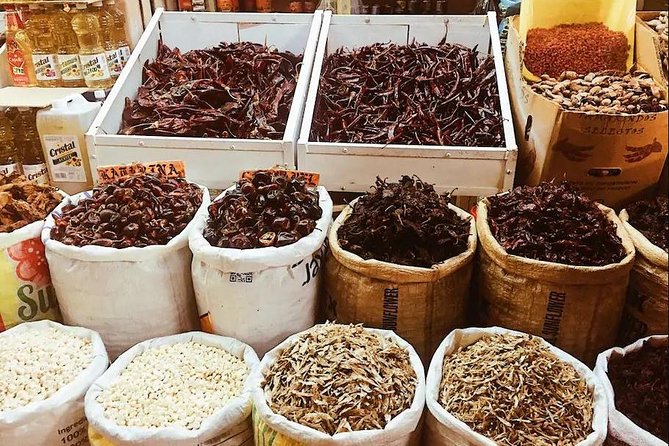
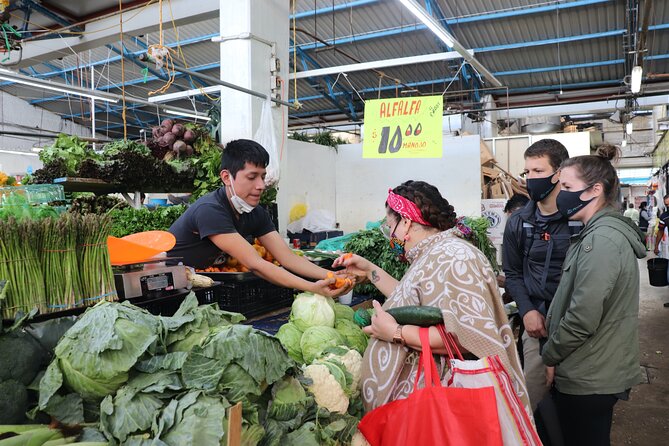
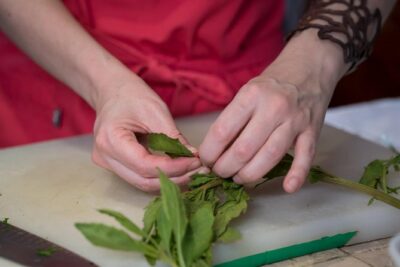
The market is more than a quick shopping stop. You will buy the fresh ingredients used in the class, with the host explaining how to select them and pointing out local produce and spices. Some classes have also included tasting fruit and finding other Mexican products, such as fresh mole, that you may want to buy separately.
This is one of the strongest parts of the experience for me. A recipe tells you to use a tomato, chile, onion, or herb. A market visit shows you how those ingredients look before they reach a supermarket shelf, and it gives you a better sense of how Mexican cooking begins with selection.
You are not just watching someone cook a prepared menu. The group chooses the ingredients together, and the host can explain how to pick them. That makes the later cooking easier to understand. You see the produce first, then watch it change through heat, chopping, blending, and seasoning.
Tacuba Market is also a working local market, not a sightseeing set built for visitors. That can be a plus if you want ordinary Mexico City life in your itinerary. It also means you should expect a real market environment rather than a quiet, carefully arranged classroom. Stay attentive to your group and belongings, and wear shoes suitable for walking.
Four salsas, four different personalities
The central lesson covers four traditional methods:
- Raw
- Fried
- Boiled
- Roasted
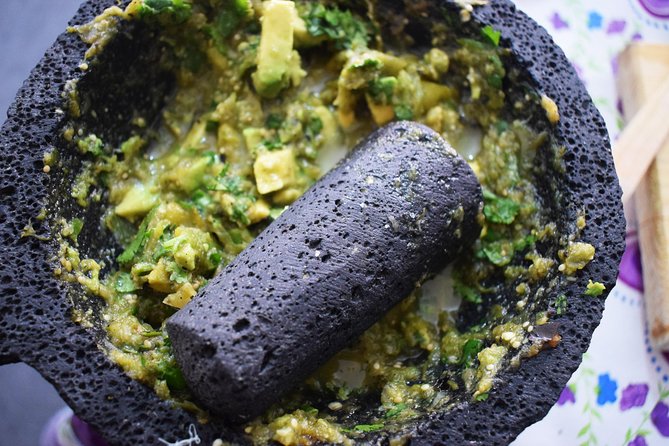
The point is not simply to produce four colors of sauce. Each technique changes the ingredients. A raw salsa keeps a fresher character. Fried ingredients bring a different depth. Boiling softens the produce, while roasting adds a cooked, smoky quality. The class lets you taste those differences as you go.
This format is especially helpful if your experience with salsa begins and ends with a jar from the grocery store. You will see that salsa is not one fixed recipe. The chile, cooking method, and amount of seasoning can shift the result from fresh and mild to hot and forceful.
Spice tolerance varies within most groups, and the hosts have adjusted recipes for different preferences. That is useful for families and mixed groups. Still, this is a chile-focused class, so do not expect every sample to be mild. If you have a strong sensitivity to heat, explain that clearly at the beginning.
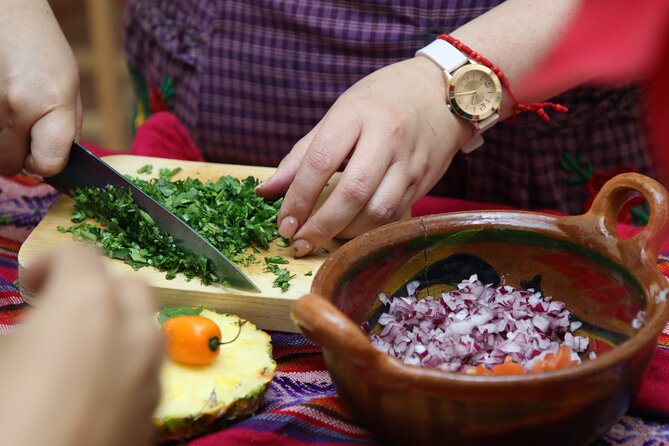
The hands-on element matters. You are not seated for a demonstration while someone else does all the cutting and cooking. The class is interactive, with participants helping prepare the food and tasting the results along the way. The exact division of tasks may depend on the size of your group and the host, but the experience is designed around doing, not just observing.
Quesadillas turn the lesson into lunch
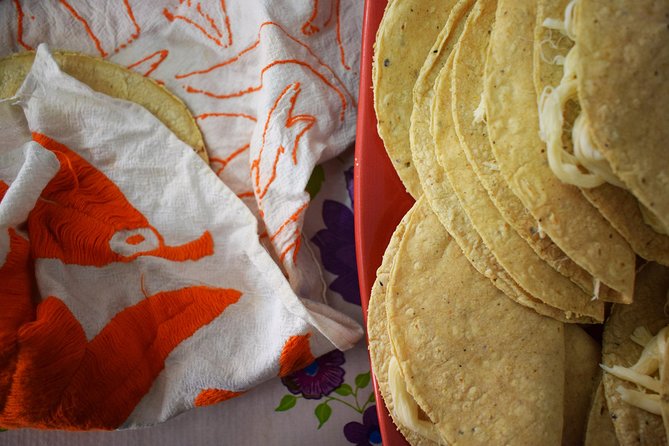
As the salsas come together, you make quesadillas with hot tortillas and melted Oaxaca cheese. The salsas are served with totopos, fried corn tortilla pieces, so you can taste them throughout the class rather than waiting for one final plate.
This makes the food part feel generous for a two-and-a-half-hour activity. You receive snacks, but the quesadillas and salsa can be filling enough to function as a light meal. Some groups have found they did not need a full dinner immediately afterward.
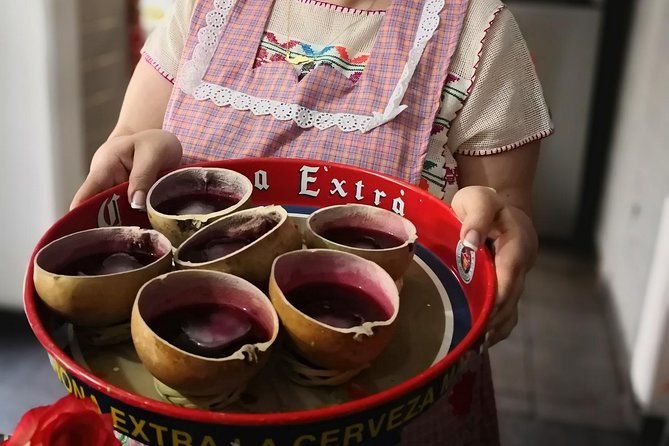
A traditional hibiscus agua fresca, called jamaica, is included with ice and a touch of sugar. The drink gives you a cool, tart counterpoint to the chiles, and refills are unlimited according to the tour details.
A vegan option is available with beans or nopales. Tell the host about this need in advance if possible, since the standard quesadilla includes Oaxaca cheese. The provided information confirms the option, but does not specify every dietary accommodation, so do not assume that all allergies or restrictions can be handled without prior discussion.
A completely different day out, same corner of Mexico City:
- Teotihuacan, Guadalupe Shrine & Tlatelolco Day Tour with Lunch
★ 5.0 · 11,603 reviews - Xochimilco, Coyoacan and Frida Kahlo with Optional Lunch
★ 4.5 · 7,320 reviews - Balloon flight + Breakfast in cave + Pyramids + Pick up CDMX.
★ 5.0 · 6,335 reviews - Teotihuacan pyramids morning or afternoon without tourist traps
★ 5.0 · 6,186 reviews
Meeting the hosts in a home kitchen
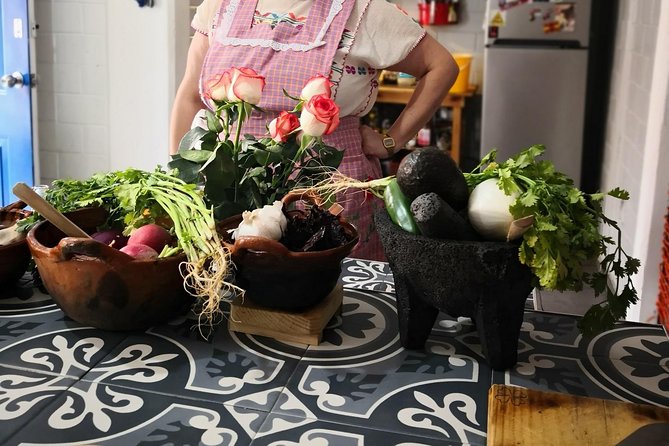
After the market, you walk about five minutes to the host’s place. The cooking takes place in a home setting, with the equipment and ingredients ready for the class. This is a different feel from a large commercial cooking school. You are closer to the host, the kitchen, and the everyday rhythm of preparing food at home.
The teaching team includes hosts named Luis, Jazz, Veronica, Yazmin, Natalia, Quesse, and others, depending on the scheduled session. Their styles differ, but the consistent strength is personal instruction. Jazz has been praised for her energy and clear English, Luis for patient teaching, Veronica for market guidance and warm instruction, Yazmin for combining cooking with stories, and Natalia for working well with families and different spice levels.
One unusual feature is that the experience may be held in more than one language at the same time. English is offered, and a French-language class has also been arranged. If language is important to you, ask ahead rather than assuming the entire session will be conducted only in English.
The home setting will suit you if you value conversation and contact with a local host. It may not suit you if you want a highly formal school with individual workstations and restaurant-style service. The point here is the welcome, the shared table, and the chance to cook in a personal space.
What the price includes at $96
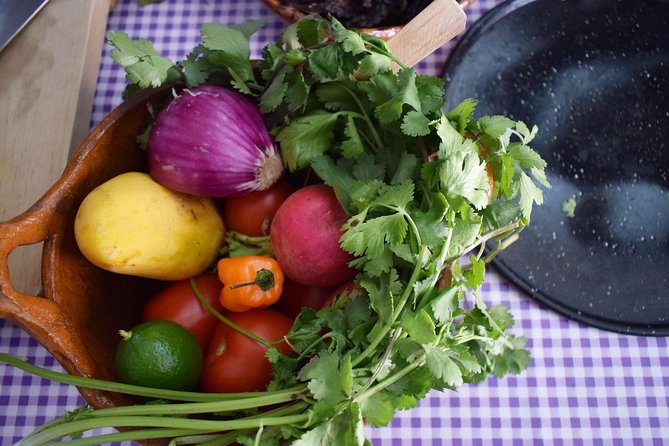
At $96 per person, this is not the cheapest way to eat salsa in Mexico City. You are paying for more than ingredients and food. The price covers the host’s time at the market, instruction in four techniques, kitchen equipment, totopos, salsas, quesadillas, agua fresca, a jar of salsa, and recipe cards.
The market visit and take-home materials improve the value. You leave with methods you can repeat, not just a meal that disappears. Four recipes also give you a practical introduction to the differences between raw, fried, boiled, and roasted salsa.
The private format matters too. Only your group participates, which gives you more room to ask questions and adjust the pace. It is a good fit for a family, a couple, or friends who want a shared activity rather than a large class.
The cost makes less sense if you mainly want a cheap lunch or a quick market walk. You will get better value if you enjoy cooking, want direct contact with a host, or plan to recreate the food at home. The class is booked about 20 days ahead on average, so it is sensible to reserve early if your Mexico City dates are fixed.
Who will enjoy this most
I would recommend this for couples, families with older children, and friends who like food-based activities. A family group with children and teenagers can take part in selecting ingredients, tasting new produce, and preparing the salsas. The class has also worked well for adult children traveling with parents.
It is a strong choice for first-time cooks because the four methods make the lesson easy to follow. It also suits cooks who already make salsa and want a local point of comparison. One California family found the recipes good enough to replace their own usual versions, but that kind of judgment is personal and depends on your taste.
The class can be a good first cooking experience in Mexico City because it is short, practical, and focused. You do not need to commit to a full-day food tour. At the same time, you should like tasting ingredients and taking part. If you prefer to sit back and watch, choose a different activity.
This is not the best pick for someone who needs guaranteed private transportation, a fully accessible route, or a strictly controlled food environment. Service animals are allowed, and the meeting point is near public transportation, but the route includes a market visit and a five-minute walk to a home. Ask the operator about any specific mobility or allergy concern before booking.
Small details that make the experience memorable
The most appealing detail is the change of pace. You begin at a church, move through a local market, then sit down in a home kitchen. Those three settings give the class more texture than a cooking lesson held in one room.
The host may also add music, costumes, photos, stories, or tastings, depending on the person leading your session. These touches have made the activity especially successful for families and for people who want more than a standard recipe lesson. They are not guaranteed parts of every booking, so treat them as possible extras rather than promised features.
The class ends with practical souvenirs. You take home a jar of salsa and recipe cards. The jar is the immediate reward, while the recipes are the lasting one. Keep in mind that food products may matter at customs when you return home, so check your destination’s rules before packing anything edible.
The activity returns to the original meeting point. That makes it easier to connect with another Mexico City plan, although you should not schedule something across town immediately afterward. Market timing, group pace, and city traffic can all affect your day.
Cancellation and booking notes
Free cancellation is available up to 24 hours before the local start time for a full refund. Changes made within 24 hours are not accepted, and cancellations inside that window are not refunded.
The experience requires good weather and a minimum number of participants. If the operator cancels for either reason, you can receive another date or experience, or a full refund. Confirmation is normally provided at booking. Bookings made within one hour of the start time are confirmed as soon as possible and depend on availability.
Should you book the Tacuba salsa class?
Book it if you want a hands-on food experience with a local market, a small private group, and recipes you can use later. The four cooking methods give the class a clear purpose, and the quesadillas, totopos, jamaica, salsa jar, and recipe cards make the $96 price easier to justify.
I would be most likely to book this early in a Mexico City visit. The market lesson can sharpen your understanding of Mexican ingredients for the rest of your meals, and the class gives you a relaxed introduction to cooking customs without taking an entire day.
Skip it if you want a polished restaurant kitchen, private transportation, or a meal with no participation. For everyone else, especially families, couples, and curious home cooks, this is a useful and personable way to spend two and a half hours in Tacuba.
FAQ
Where does the salsa class meet?
It begins at Parroquia San Gabriel Arcángel, Calz México-Tacuba S/N, Tacuba, Miguel Hidalgo, 11490 Ciudad de México, CDMX, Mexico.
Where does the activity end?
The activity ends back at the original meeting point.
How long does the experience last?
It lasts approximately 2 hours and 30 minutes.
How much does the experience cost?
The price is $96 per person.
Is transportation included?
No. Private transportation is not included. The meeting point is near public transportation.
What languages are offered?
English is offered. The experience may also be held in more than one language at the same time, and different language arrangements may be possible by request.
How many people participate?
This is a private activity, so only your group participates.
What food is included?
The included food consists of salsas, totopos, quesadillas, and agua fresca made with hibiscus flower. Cooking equipment is also included.
Is there a vegan option?
Yes. A vegan option is available with beans or nopales.
Can I cancel for a refund?
Yes. You can cancel at least 24 hours before the local start time for a full refund. Cancellations within 24 hours are not refunded.
Just added around Mexico City
- Mexico City: Hop-on Hop-off City Tour by Turibus 2-Day Pass★ 4.0 · 10 reviews
- Anthropology Museum, Chapultepec Castle & Cable Car Tour★ 4.5 · 10 reviews
- Multi-Variety Mole Class in a Condesa home or art gallery rooftop★ 5.0 · 10 reviews
- PRIVATE TOUR Colonial Town Taxco and Cuernavaca from CDMX.★ 5.0 · 10 reviews
- El Centro Street Food Walking Tour★ 5.0 · 10 reviews
- Private Round-Trip Transportation to Teotihuacan Pyramids★ 5.0 · 10 reviews
- Teotihuacan and My Grandma’s Food Tour★ 5.0 · 10 reviews
- Private Walking Tour Legends and Events Historic Center CDMX★ 4.8 · 10 reviews
Mexican Cooking Classes, compared.
Mexican Cooking Class with Food Market Visit in Mexico City
Read our review →
Essence of Mexico: Authentic Mexican Cooking Class & Market Tour
Read our review →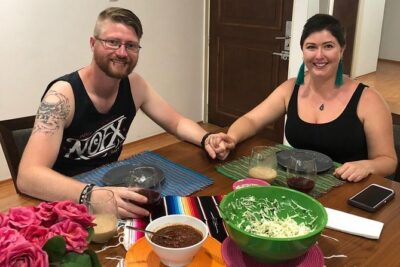
Mexican Cooking Class & Cocktails in Mexico City
Read our review →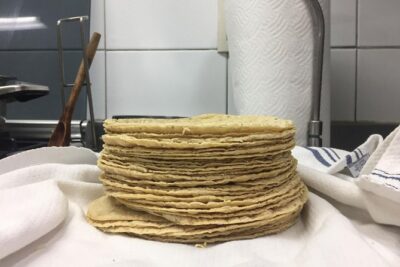
Private Mexican Cooking Class with Gastronomic Historian, Lucia
Read our review →
3h Cooking Class in Mexico City: 8 Recipes & Bottomless Drinks
Read our review →
Private San Angel Tour & Cooking Class in Mexico City with Lucia
Read our review →Browse the lists this tour appears in