Reviewed · GUIDED
Discover Mexico City: 3-Day Private Guided Tour
Mexico City’s best-known sights are spread across a huge urban area, and this three-day private tour links them by vehicle instead of leaving you to fight the city’s distances alone. You move from the pyramids of Teotihuacan to Aztec ruins, Diego Rivera’s art, Frida Kahlo’s home, and the canals of Xochimilco.
I like the private guide, which lets you ask questions and adjust the pace, and I like that entry tickets, transport, non-alcoholic drinks, and snacks are built into the price. The main caution is the packed schedule: you will see a great deal, but several stops allow only about an hour, and the listed three-minute visit at Chapultepec Castle should be confirmed before booking.
In This Review
- Key points at a glance
- Why this three-day route works
- Day 1: Teotihuacan, Guadalupe, and the city center
- Teotihuacan’s Avenue of the Dead
- Basilica of Santa Maria de Guadalupe
- Mexico City’s Historic Center
- Day 2: Canals, Rivera, UNAM, and Coyoacan
- Xochimilco by trajinera
- Museo Diego Rivera Anahuacalli
- UNAM’s Central Library
- Coyoacan and the Blue House
- Day 3: Chapultepec and Mexico’s great national museum
- Chapultepec Castle above Paseo de la Reforma
- National Museum of Anthropology
- What $450 per person buys you
- Timing, comfort, and practical limits
- Who should book this Mexico City tour?
- Should you book it?
- FAQ
- How long is the Discover Mexico City tour?
- Is this a private tour?
- Where does the tour start?
- Are entrance fees included?
- Are meals included?
- What language is the tour offered in?
Key points at a glance
- Teotihuacan comes first, with about three hours for the Avenue of the Dead, the Pyramids of the Sun and Moon, and the Temple of Quetzalpapalotl.
- A private vehicle connects far-flung sights, including Xochimilco, Coyoacan, UNAM, and the museums in Chapultepec.
- Frida Kahlo and Diego Rivera receive separate attention, through the Blue House and the Anahuacalli Museum.
- The cultural range is unusually broad, moving from pre-Hispanic archaeology to colonial architecture, modern Mexican art, and present-day Indigenous traditions.
- The tour suits first-time visitors, especially if you want an organized introduction rather than several separate day trips.
- The pace is brisk, so you should expect orientation visits as well as full guided museum stops.
Why this three-day route works
Mexico City can be hard to plan by neighborhood. Teotihuacan lies outside the central city, Xochimilco is far to the south, and Chapultepec, Coyoacan, and the Historic Center each deserve serious time. This plan groups the major sights into three long days and uses a private vehicle to handle the gaps.
That matters most if you have only a short stay. You can cover ancient temples, religious landmarks, public murals, art museums, canals, and major civic spaces without arranging separate transport for each one.
The private format also changes the feel of the day. You travel only with your own group, and the guide can explain what you are seeing in English. Most guides speak Spanish and English. Other languages may be possible by request, with an added fee, so confirm that before paying.
Two guides named in the available feedback are Alex and Carlos. Alex was praised for introducing Mexican customs and places that were not obvious choices. Carlos received special praise for helping an elderly mother enjoy the day, which suggests that a private guide can be useful when your group needs a gentler pace or extra assistance.
Other Mexico City days people book alongside this one:
- Teotihuacan, Guadalupe Shrine & Tlatelolco Day Tour with Lunch
★ 5.0 · 11,603 reviews - Xochimilco, Coyoacan and Frida Kahlo with Optional Lunch
★ 4.5 · 7,320 reviews - Balloon flight + Breakfast in cave + Pyramids + Pick up CDMX.
★ 5.0 · 6,335 reviews
Day 1: Teotihuacan, Guadalupe, and the city center
The first morning begins at 9:00 a.m. The stated meeting point is at the Angel of Independence on Paseo de la Reforma, though hotel pickup and drop-off are included with the private option. Make sure the operator has a working phone number with the international prefix. The guide may need it on the day, and failing to respond can result in a no-show.
Teotihuacan’s Avenue of the Dead
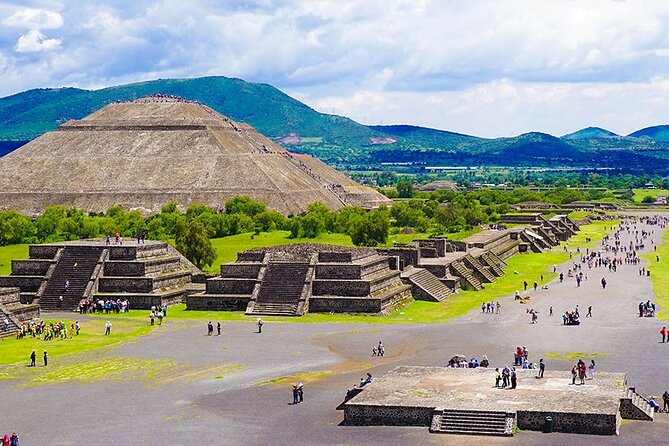
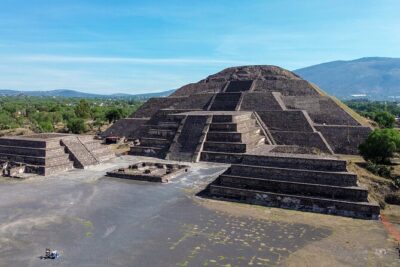
The drive to Teotihuacan leads to the strongest archaeological stop on the tour. You have about three hours in the zone, enough for a measured walk along the Avenue of the Dead and visits to the Pyramids of the Sun and Moon.
The scale is the point. Teotihuacan was once one of the great cities of ancient Mesoamerica, and its broad ceremonial avenue gives you a clear sense of how carefully the city was laid out. The Pyramids of the Sun and Moon dominate the visit, but the Temple of Quetzalpapalotl adds detail through its carved and decorative elements.
A guide is especially useful here because the site can otherwise become a series of impressive stones without much explanation. You can ask about the buildings, the city’s purpose, and the cultures that shaped the complex. Admission is included, and after the visit you return to the private vehicle for the ride back toward Mexico City.
Wear practical walking shoes. Three hours sounds generous, but the zone is large and the route involves outdoor walking. The tour description says you will explore leisurely, yet the rest of the day still lies ahead, so do not expect unlimited time at every structure.
Basilica of Santa Maria de Guadalupe
The Basilica receives about two hours. This is not simply a quick photo stop. It is one of the world’s most visited religious destinations and the center of devotion to the Virgin of Guadalupe.
Your guide explains the reported 1531 appearance of the Virgin Mary to Juan Diego and the importance of the cloak said to preserve her image. The visit gives the itinerary a living religious dimension that archaeological sites and museums cannot provide.
You can walk around the complex and take in its importance to Mexican Catholic life. Keep your tone respectful, especially if services or personal acts of devotion are taking place. The stop is included with admission and a guided visit.
A few more Mexico City half-days to weigh up
- Teotihuacan Private Tour from Mexico City
★ 5.0 · 1,890 reviews - Private Tour: Teotihuacan and Guadalupe Shrine
★ 5.0 · 938 reviews - Private City Tour in Frida Kahlo, Coyoacan, and Xochimilco
★ 5.0 · 626 reviews - Mexico City Custom Private Tour with a Local, Highlights & Hidden Gems
★ 5.0 · 582 reviews
Mexico City’s Historic Center
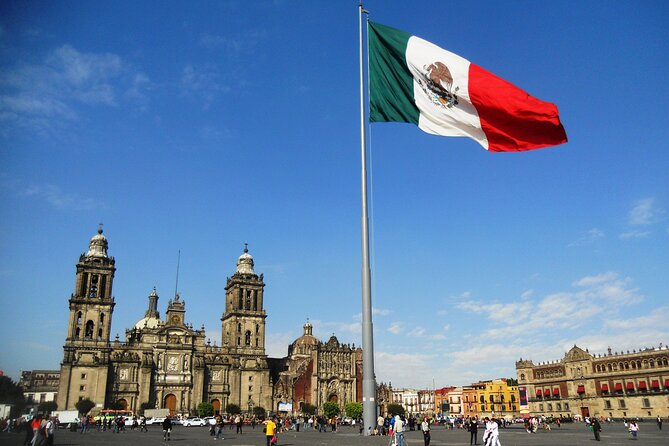
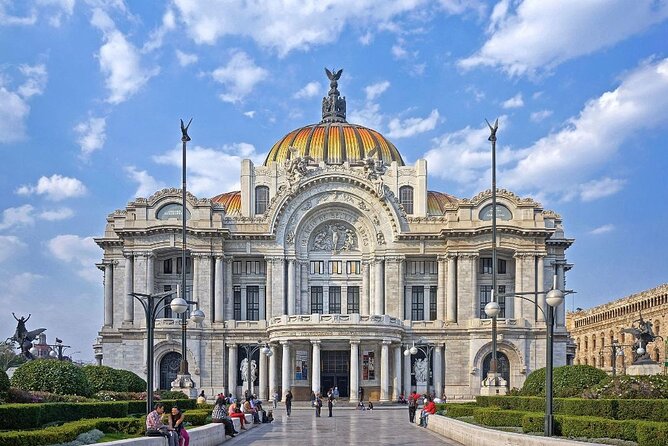
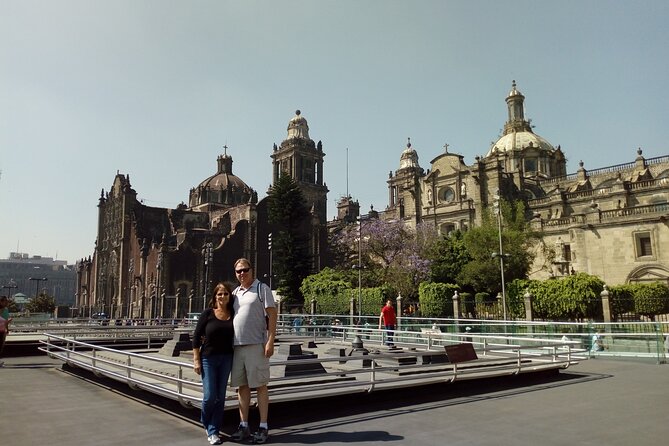
The final major stop of the day is the Historic Center, with about three hours to walk through the core of Mexico City. The route includes the Zocalo, the remains of Templo Mayor, Madero Avenue, the Palace of Fine Arts, and other major cultural sites.
This area compresses several eras into a few blocks. The city once known as Tenochtitlan was the capital of the Aztec Empire. Spanish colonial power then reshaped the center, and later civic buildings and museums added new layers. That mixture explains why the area feels less like a single historic quarter and more like a record of the city’s changing identity.
The Zocalo is the natural starting point. From there, Templo Mayor shows how the modern city sits over the former Aztec capital. Madero Avenue leads toward the Palace of Fine Arts, whose architecture reflects strong European influence in twentieth-century Mexico.
The three-hour visit should give you a useful orientation, but it cannot cover every museum in the center. The value here is having someone connect the major places rather than trying to absorb each building on its own. Day one is already full, so plan on a long day with plenty of walking.
Day 2: Canals, Rivera, UNAM, and Coyoacan
Day two shifts south and changes mood. Instead of monumental plazas and pyramids, you see waterways, university murals, artist neighborhoods, and two different views of Mexican modernism.
Xochimilco by trajinera
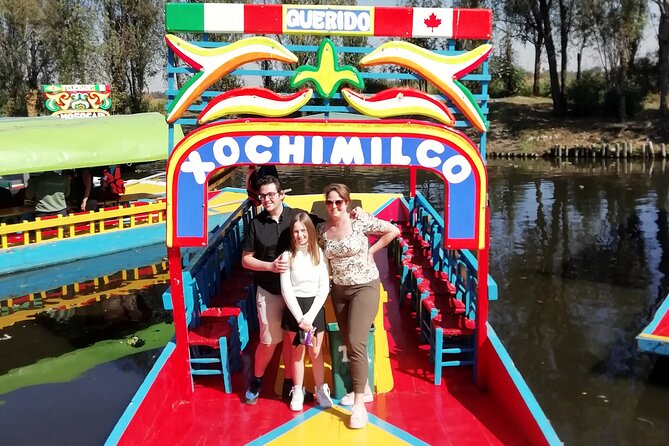
Xochimilco receives about two hours, including a ride in a trajinera, the colorful flat-bottomed boat often compared to a Mexican gondola. The canals began in the pre-Hispanic period, when the Mexico Valley contained an extensive system of lakes and lagoons.
Today, Xochimilco combines those old waterways with music, mariachis, marimba, parties, and local traditions. The boat ride is included, so you are not left arranging the main activity once you arrive.
This is one of the tour’s more social and relaxed stops, although its atmosphere can vary. Xochimilco is not presented as a quiet nature excursion. It is a cultural outing shaped by boats, music, and celebration. If you prefer silent ruins and formal museums, this may feel less controlled. If you want to see a different side of Mexico City, it adds welcome variety.
Museo Diego Rivera Anahuacalli
The Anahuacalli Museum gives Diego Rivera’s pre-Hispanic art collection its own setting. The name means house surrounded by water in Nahuatl, and Rivera designed the building to hold the collection.
The structure is made from local volcanic rock associated with the Pedregal area, formed by the eruption of the Xitle volcano. That material makes the building part of the experience. You are not simply entering a standard gallery, but a museum shaped around Rivera’s interest in ancient Mexican art and architecture.
You have about one hour here. That is enough for an introduction, though anyone especially interested in Rivera or pre-Hispanic objects may want more time than the schedule allows. The entrance ticket and guided visit are included.
UNAM’s Central Library
The UNAM stop is brief, about 30 minutes, but it gives you a chance to see one of Mexico City’s most distinctive public artworks. The Central Library at the National Autonomous University of Mexico holds one of the country’s largest book collections, and its exterior is covered with murals by Juan O’Gorman.
The campus is protected as a UNESCO World Heritage site. With only half an hour, this is an orientation walk rather than a full campus visit. The guide can help you read the facade and place the building within Mexico’s modern cultural life.
Do not expect a long museum-style stop here. Think of it as a focused look at a major mural-covered building.
Coyoacan and the Blue House
Coyoacan receives about two hours before the Frida Kahlo Museum visit. Its Nahuatl name means place of coyotes, and the neighborhood is linked with artists such as Frida Kahlo, Diego Rivera, and David Alfaro Siqueiros.
The orientation walk is useful because it puts the Blue House in its neighborhood setting. You can see Coyoacan as more than a museum address, with cultural spaces, galleries, and areas where artists and craftspeople display their work. The stop also offers a look at daily urban life away from the central government quarter.
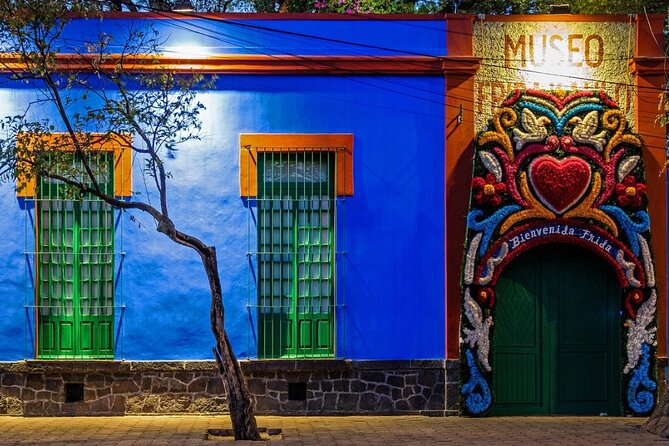
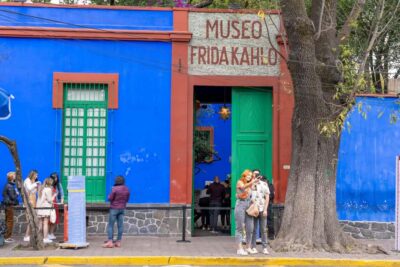
The Museo Frida Kahlo, known as the Blue House, follows for about one hour. Kahlo lived there first with her family and later with Rivera. After her death, Rivera donated the house and its contents so it could become a museum.
The rooms remain much as they were in the 1950s. You see Kahlo and Rivera’s work, Mexican folk art, and pre-Hispanic objects within the house itself. That setting is the main reason to visit. It gives personal context to the artist rather than presenting her paintings in a detached gallery.
The museum is one of the most visited places in Mexico City, so the one-hour schedule is sensible for a first look but may feel short if Frida Kahlo is your main interest. The tour includes admission and a guided visit, which removes one important planning task.
Day 3: Chapultepec and Mexico’s great national museum
The last day stays closer to central Mexico City and focuses on national identity, political history, archaeology, and Indigenous cultures.
Chapultepec Castle above Paseo de la Reforma
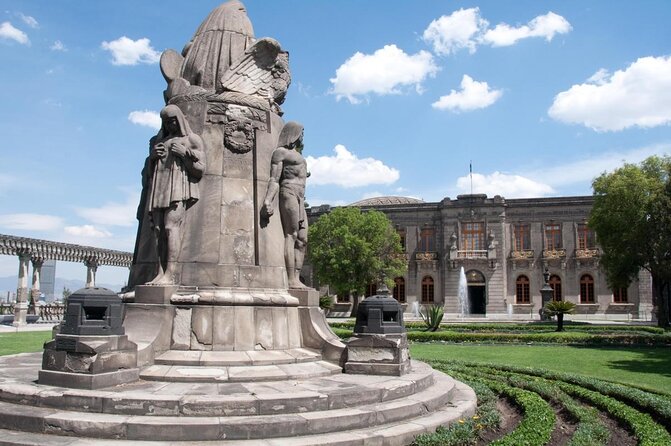
The route begins with a drive along Paseo de la Reforma, one of the city’s famous avenues. You then climb the hill in Chapultepec Park to reach the castle.
Chapultepec Castle has served several major roles. It was an official residence for viceroys, Emperor Maximilian of Habsburg, and several Mexican presidents. The building lets you move through different periods of Mexican political history in a single visit.
The supplied schedule lists three minutes for this stop, which cannot represent a normal castle visit and likely reflects a timing error. Because the tour includes admission and a guided visit, ask the provider to confirm the actual time before booking. The climb up the hill is also worth keeping in mind if anyone in your group has mobility concerns.
National Museum of Anthropology
The National Museum of Anthropology is given about three hours, making it the most substantial museum visit of the trip. It holds the world’s largest collection of ancient Mexican art and also presents ethnographic exhibits about Mexico’s Indigenous communities today.
The museum occupies two large floors and includes ancient human remains and major art objects. The Olmec Group of Figures and the 22-ton Aztec Sun Stone are among the key works named for the visit.
Three hours gives you a strong introduction, but this is not a museum you can fully exhaust in one morning. Your guide can help you decide which rooms deserve the most attention and explain why the objects matter. Without that help, the museum’s size could be tiring or confusing, especially after two packed days.
This final stop also balances the archaeological focus at Teotihuacan. There, you walk through an ancient city. Here, you see objects from several cultures and learn about Indigenous communities in the present day.
What $450 per person buys you
The price is $450 per person, with group discounts available. That is a substantial cost, but you are paying for three days of private guiding, a private vehicle, pickup and drop-off for the private option, entrance fees, and a trajinera ride.
The value is strongest if you are traveling with several people and want the convenience of a private arrangement. You avoid piecing together long taxi rides, museum tickets, and separate day tours. A guide also gives context at sites where a quick visit could otherwise feel thin.
The price is less attractive if you are comfortable using public transport, arranging your own tickets, and visiting only a few major sights. Meals, personal expenses, tips, and travel insurance are not included. Drinks and snacks are included, but you should still budget for meals across three full days.
The operator notes that the online selling platform may add a commission of up to 30 percent. That limits room for discounts, so compare the final price carefully and ask about the group rate if you are booking for several people.
Timing, comfort, and practical limits
The tour starts at 9:00 a.m. and ends back at the meeting point. The stated starting location is the Angel of Independence, at Av. Paseo de la Reforma 342, though private-tour pickup may be arranged from your hotel.
Hotel pickup and drop-off are included only for the private option. A pickup from areas outside the stated service area may cost an additional $10 to $40. Confirm that detail before booking.
Most people can participate, but the schedule includes outdoor walks, archaeological paths, the climb toward Chapultepec Castle, and long museum days. Carlos was specifically praised for helping an elderly mother enjoy the experience, yet you should still explain any mobility needs in advance.
The tour is offered in English, and most guides speak Spanish and English. Other languages require advance confirmation and may cost extra.
Cancellation deserves careful attention. The experience is normally non-refundable and cannot be changed for personal reasons. If poor weather cancels the tour, you are offered another date or a full refund. The same applies if the minimum number of participants is not met.
Who should book this Mexico City tour?
I would choose this tour if you have three days, want the major sights handled in one plan, and value direct access to a private guide. It is especially useful for families, mixed-age groups, and first-time visitors who do not want to manage long cross-city transfers.
You will also get the most from it if your interests span several subjects. The route covers Aztec and other pre-Hispanic cultures, Catholic tradition, colonial and republican Mexico, Frida Kahlo, Diego Rivera, public murals, university architecture, and present-day Indigenous cultures.
I would hesitate if your priority is a slow museum schedule. The Blue House, Anahuacalli, UNAM, and the National Museum of Anthropology all deserve more time than the itinerary can provide for a specialist. The Historic Center also offers enough museums and buildings for several days by itself.
Should you book it?
Book this three-day private tour if you want maximum coverage with minimum planning. It gives you the city’s essential sights, includes the costly admissions and transport, and leaves room for a guide to explain the connections between them.
Skip it if you prefer independent wandering, long meals, or several hours in each museum. Before paying, confirm the Chapultepec timing, pickup location, guide language, and any extra transport fee. For a short first visit, though, this is a strong way to understand how Mexico City connects ancient cities, living traditions, and modern Mexican art.
FAQ
How long is the Discover Mexico City tour?
The experience lasts approximately three days and begins at 9:00 a.m. It ends back at the meeting point.
Is this a private tour?
Yes. This is a private activity, so only your group participates. Private-tour pickup and drop-off are included.
Where does the tour start?
The stated meeting point is the Angel of Independence at Av. Paseo de la Reforma 342, Juarez, Cuauhtemoc, Mexico City. Confirm pickup details if you are booking the private option.
Are entrance fees included?
Yes. Entrance tickets are included for Teotihuacan, the Basilica of Guadalupe, the Anahuacalli Museum, the Frida Kahlo Museum, Chapultepec Castle, and the National Museum of Anthropology, along with the guided visits listed in the program.
Are meals included?
No. Meals, personal expenses, travel insurance, and tips are not included. Non-alcoholic drinks and snacks are included.
What language is the tour offered in?
The tour is offered in English, and most guides speak Spanish and English. Other languages may be available by request, with possible additional fees. Confirm before booking.
Just added around Mexico City
- Ticket to Frida Kahlo Museum (Blue House)★ 5.0 · 3 reviews
- Valle de Bravo: Forest Hiking Adventure★ 4.4 · 3 reviews
- Chapultepec Castle and Anthropology Tour, starting from CDMX★ 5.0 · 3 reviews
- La Roma Private Art Tour★ 5.0 · 3 reviews
- Private Transportation: Pickup and Drop-Off★ 5.0 · 3 reviews
- Grutas de Tulantongo★ 3.0 · 3 reviews
- Mexico City: Relaxing or Decontracting Massage Experience★ 5.0 · 3 reviews
- Mexico City: Local Walking Tour with Mezcal & Wrestling Show★ 5.0 · 3 reviews
Guided, compared.
Teotihuacan Early Access Guided Tour with optional Lunch
Read our review →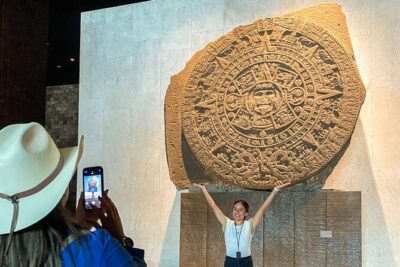
Frida Kahlo Museum Entry Ticket w/Digital Guide
Read our review →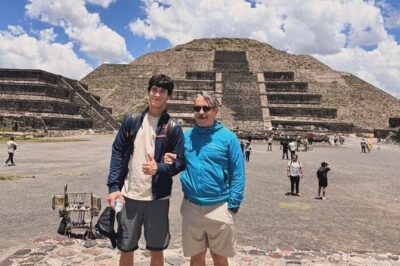
Guided Tour in Teotihuacan with Cave Breakfast and Transportation
Read our review →
Teotihuacan Private Tour with Expert Guide & Cultural Insights
Read our review →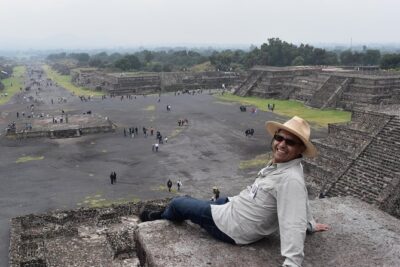
Teotihuacan Early Morning Tour: Avoid Crowds, & Expert Guide
Read our review →