
Reviewed · FRIDA KAHLO & COYOACáN TOURS
La Catrina & Muralism: Diego Rivera’s Legacy & Frida Kahlo
Mexico City’s murals are not just large paintings on old walls. They are public arguments about revolution, class, religion, death, labor, and national identity. This walking tour gives you the stories behind those images, from Diego Rivera and Frida Kahlo to the artists who followed them.
I like two things right away: the small maximum of 12 people keeps the walk personal, and museum admission plus public transportation are included. Guides such as Sofía, Ulysses, Addy, Diana, and Warryor are praised for making complicated art and Mexican history easy to follow. The tour also reaches murals tucked inside market spaces and buildings you might pass without noticing.
The main caution is timing. It is advertised at about two and a half hours, but some outings have lasted three and a half to more than four hours. Bring water, consider a snack, and avoid booking a tight lunch or museum appointment afterward.
In This Review
- Key points before you book
- Why Mexican muralism matters in Mexico City
- San Ildefonso, where Rivera and Kahlo’s story begins
- Museo Vivo del Muralismo and three levels of public art
- La Catrina and the Diego Rivera Mural Museum
- Palacio de Bellas Artes and Rivera’s controversial mural
- The off-route murals are part of the appeal
- Walking, transport, and the time you really need
- Is $66.14 a fair price?
- Who will enjoy this mural walk most?
- My verdict on La Catrina and Mexican muralism
- FAQ
- Where does the tour begin?
- What time does the tour start?
- Where does the tour end?
- How long is the tour?
- Is the tour offered in English?
- Are museum tickets included?
- Is public transportation included?
- Can most people participate?
Key points before you book
- La Catrina gets a full historical setting: See how José Guadalupe Posada’s skeleton became an icon, then follow her into Diego Rivera’s famous mural.
- San Ildefonso connects Rivera and Kahlo: The former college is tied to the beginning of their relationship and to Mexico’s modern art story.
- Market murals add a local angle: Your guide may take you to public art in places you would be unlikely to find alone.
- The tour links art to politics: Rivera, José Clemente Orozco, David Alfaro Siqueiros, and their circle used murals to tell competing versions of Mexico.
- Small groups help with questions: The maximum is 12 people, with the experience offered in one language, English.
- Plan for standing and walking: There are no scheduled food or drink stops, and the actual duration may run well past the stated two hours and 30 minutes.
Why Mexican muralism matters in Mexico City
The best way to approach this tour is not as a checklist of paintings. Think of it as a walk through the ideas that shaped modern Mexico after the Revolution.
Mexican muralism brought art into public buildings rather than keeping it inside private galleries. The artists painted workers, Indigenous communities, political leaders, religious symbols, battles, and ordinary people. Their goal was often educational, but the murals also carried sharp political opinions.
That makes a guide especially useful. You can look at a crowd of painted figures and admire the colors, yet miss who is being honored, criticized, or deliberately left out. A strong guide points out symbols, explains the political climate, and helps you see how one artist’s version of Mexican history can conflict with another’s.
Guides including Ulysses, Sofía, Addy, and Warryor have been praised for clear storytelling and a strong personal connection to the subject. That matters here because the tour covers several artists and large amounts of history in a short time. You are not simply being led from one wall to another. You are being given a way to read the city.
The one-language format also helps. The guide can keep the story moving without switching back and forth between languages. For an art walk filled with names, dates, symbols, and political references, that makes the experience easier to follow.
More Frida Kahlo and Coyoacán walks:
- Xochimilco, Coyoacan and Frida Kahlo with Optional Lunch
★ 4.5 · 7,320 reviews - CDMX: Xochimilco, Coyoacan, Frida Kahlo Museum & Murals Tour
★ 4.4 · 3,025 reviews - Frida Kahlo VIP [Museum Tickets Included] Bike, Markets & Churros
★ 5.0 · 1,072 reviews
San Ildefonso, where Rivera and Kahlo’s story begins
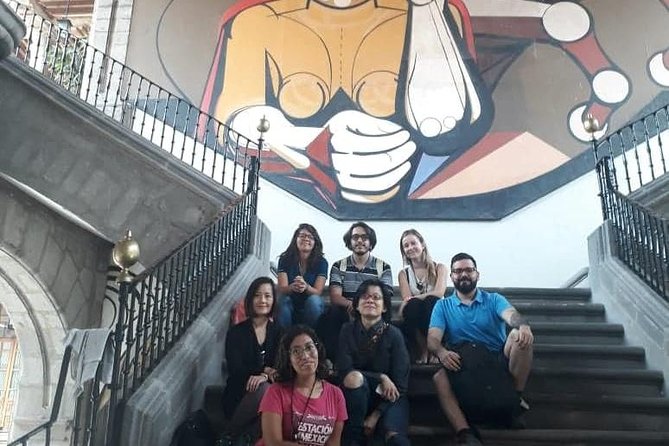
The meeting point is the former College of San Ildefonso, at Justo Sierra 16 in Centro Histórico. The tour starts at 11 a.m., and this first stop lasts about 35 minutes, with admission included.
San Ildefonso is important for more than its architecture. The building witnessed the beginning of the relationship between Diego Rivera and Frida Kahlo, the couple most closely associated with Mexican art in the public imagination. Your guide begins with Rivera’s life and work, giving you a personal entry point before moving into the larger mural movement.
I like this opening because it avoids treating Rivera and Kahlo as isolated celebrities. Their story is connected to the schools, institutions, and public art projects that helped shape Mexican culture. The site gives the tour a human starting point before the focus shifts toward politics and national identity.
You should expect this to be a storytelling stop as much as a viewing stop. The 35 minutes is enough for an introduction, but not enough for a full museum visit or a complete study of Rivera and Kahlo. If you already know their work, use this section to ask focused questions about their relationship, Rivera’s early career, or the role of public art in post-Revolution Mexico.
Museo Vivo del Muralismo and three levels of public art
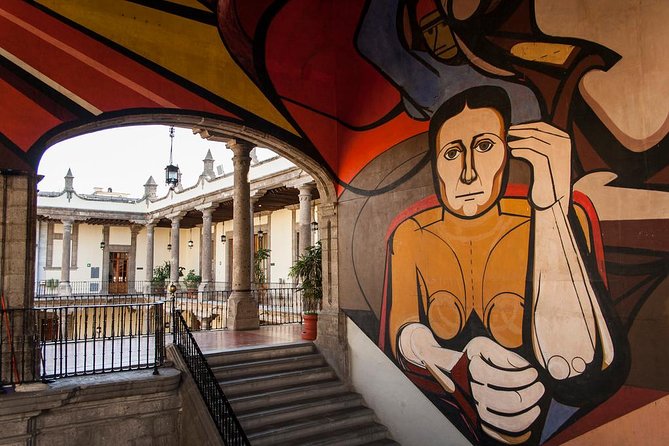
The second stop is Museo Vivo del Muralismo, a site arranged around two courtyards and three levels. About 35 minutes are set aside, and entry is included.
The design of the museum matters. Two courtyards and three levels mean you encounter the murals as part of a building rather than as a single isolated picture. You can pay attention to how the art works with corridors, stairs, open spaces, and civic architecture.
This is one place where a guide can save you time and confusion. Large mural collections can feel overwhelming, especially when several artists use different symbols and styles. Your guide helps identify the key works and explains how they fit into Mexican muralism.
The tour’s broader focus includes Rivera, Orozco, and Siqueiros. That is important because Rivera is only one part of the story. Orozco’s work can feel more skeptical and dramatic, while Siqueiros is known for forceful political energy and experimental approaches. The point is not to rank them. It is to see how three major muralists handled history, power, and the Mexican people in different ways.
Some of the most memorable parts may be the works that are not famous outside Mexico. The route can include murals in market areas and public buildings. These settings make the art feel less like a formal cultural stop and more like part of the city’s daily life.
La Catrina and the Diego Rivera Mural Museum
The third stop is Museo Mural Diego Rivera, with about 30 minutes inside and admission included. This is where you see one of the defining works of Mexican muralism, a painting that brings together Día de Muertos imagery and the figure of La Catrina.
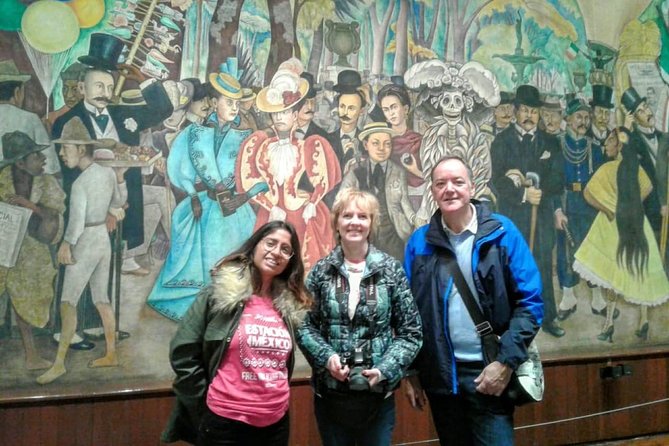
La Catrina began as a satirical skeleton created by José Guadalupe Posada. Rivera transformed the figure into a central character in his mural Sueño de una tarde dominical en la Alameda Central, or Dream of a Sunday Afternoon in the Alameda Central. The work is crowded with figures from Mexican history, popular culture, and Rivera’s own life.
You do not need to arrive with an art degree to appreciate it. The pleasure is in learning how the characters connect. La Catrina is not only a Día de Muertos image. She can also be read as a comment on class, European influence, political power, and the way Mexico remembers its past.
Thirty minutes can pass quickly here. The mural has enough figures and visual clues to occupy much longer, so listen for the guide’s main points rather than trying to memorize every face. Ask which historical figures Rivera included and how the mural reflects his political views.
This stop is especially useful if you know La Catrina mainly from souvenirs, face paint, or holiday decorations. The museum places her in a wider artistic and political setting. You see how a skeleton became one of Mexico’s most recognizable cultural symbols.
More mural and street art walks in Mexico City:
- Mexico City; ART NACO : Murals & Street Art Bike Tour
★ 5.0 · 284 reviews - Walking Tour – Impressive murals in Historical Center of Mexico City
★ 5.0 · 224 reviews - Mexico City: Art Naco, murals & street art bike tour
★ 4.7 · 166 reviews - Xochimilco floating gardens, Coyoacan and UNAM murals
★ 4.0 · 53 reviews
Palacio de Bellas Artes and Rivera’s controversial mural
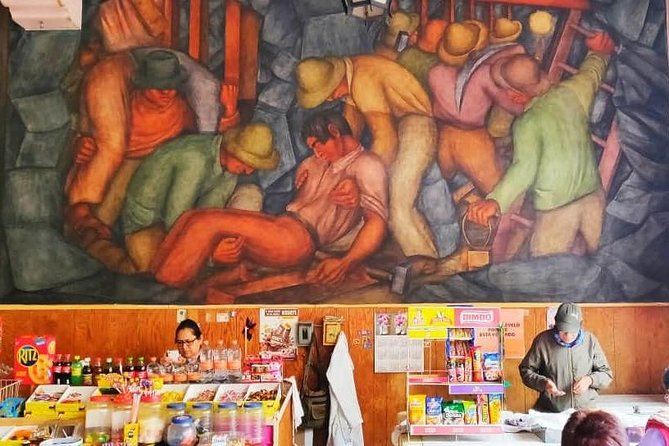
The tour ends near Palacio de Bellas Artes, Mexico City’s most important cultural venue. The planned visit lasts about 30 minutes, and the end point is on Avenida Juárez in Centro Histórico.
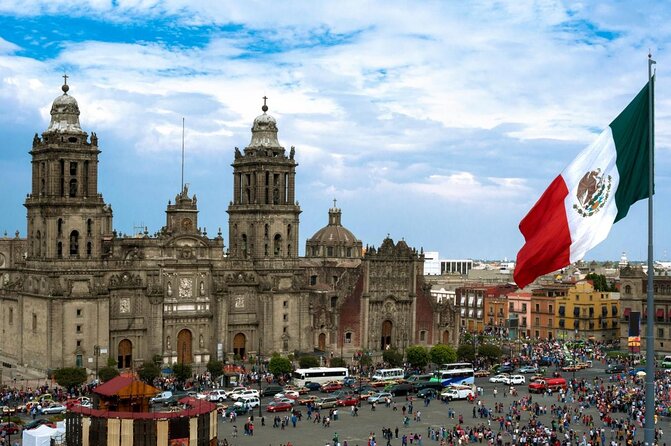
Bellas Artes is a fitting final stop because it brings Rivera’s public art into an international political story. The building houses Rivera’s controversial mural created in the United States, now preserved for public viewing in Mexico.
This section gives the tour a strong closing question: who controls a work of public art? Rivera’s mural became controversial because of its political content, and its presence in Mexico City reflects a clash between an artist’s beliefs, a patron’s expectations, and the public’s right to see the work.
Your guide can help you look beyond the surface. Notice how Rivera used public walls to argue about capitalism, labor, technology, and social change. The mural is not presented as neutral decoration. It is a statement, and the controversy is part of its meaning.
The official route ends near Bellas Artes, where the guide shares tips about nearby things to do and places to eat. This is useful planning-wise. You can continue exploring Centro Histórico, make your way to another cultural stop, or sit down for lunch. Just remember that the tour may run longer than the stated time, so keep your afternoon flexible.
The off-route murals are part of the appeal
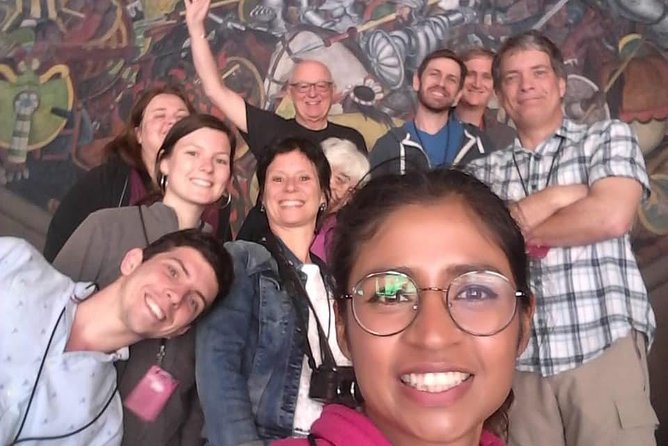
The named museums give the tour its structure, but the public art between stops may be the most distinctive part. Several guides have taken people to murals in markets and other public spaces that are easy to miss on your own.
That is a real advantage. You can locate major museums with a map, but a mural tucked into a market corridor is different. You may walk through the building without realizing that an important work is nearby. A guide who knows the area can point out these pieces and explain why they matter.
This also gives you a more grounded sense of muralism. The art is not always behind a grand entrance or presented in a quiet gallery. It can appear where people shop, work, pass through, and gather. That setting reinforces the original purpose of muralism as public art for a broad audience.
The route can vary. The information allows for museum changes based on availability, and a few accounts describe substitutions or changes in the stops. Treat the four locations as the planned backbone, not a guarantee that every detail will be identical on every departure.
Walking, transport, and the time you really need
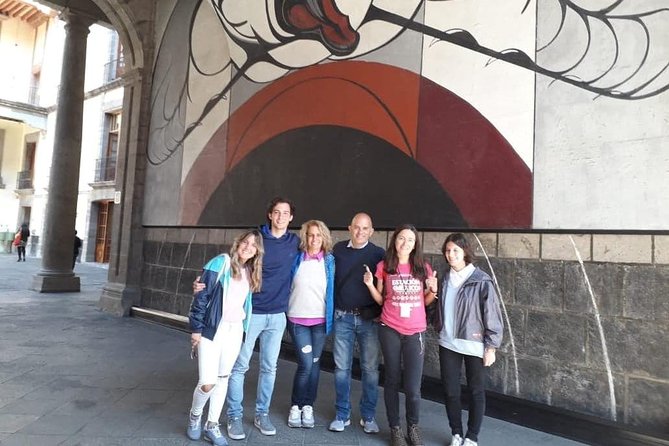
The tour includes public transportation, which keeps the outing affordable and connects the central sites without requiring a private vehicle. You meet at San Ildefonso and finish near Bellas Artes, both in Centro Histórico.
You need to be comfortable walking and standing. One account described the experience as almost entirely standing, with no formal water or restroom breaks. Most people can participate, but this is not a seated lecture or a slow café-to-café outing.
The stated duration is approximately two hours and 30 minutes. In practice, the pace and route can vary. Some outings have stretched to three and a half hours or more, especially when the guide spends extra time answering questions or adds another mural.
I see that as both a strength and a planning issue. Extra time can mean better explanations and more art. It can also leave you hungry, thirsty, or late for the next item on your schedule.
Bring water and a small snack. Wear comfortable shoes. If you have a midday reservation, allow a generous buffer. The tour begins at 11 a.m., so an unexpectedly long walk can run into lunchtime.
Is $66.14 a fair price?
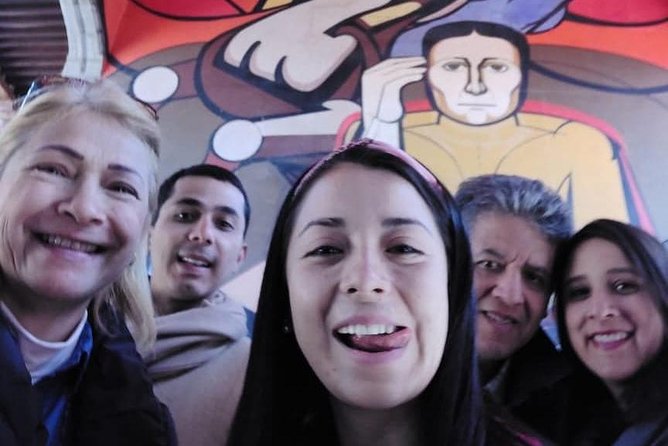
At $66.14 per person, this is not the cheapest way to see central Mexico City. You could visit some public buildings independently for less, and many city murals can be viewed without paying for a guide.
The value comes from the interpretation and the included museum tickets. You are paying to connect several places, artists, and historical arguments in one outing. Public transportation is also included, and the group maximum of 12 helps keep the guide available for questions.
For me, the price makes the most sense if you are genuinely interested in art, Mexican history, Frida Kahlo, Diego Rivera, or public architecture. If you only want a quick look at one famous mural, independent visits may be better value.
It is also a practical first introduction. Rather than spending hours trying to work out which buildings matter, you get a guided route through central sites and suggestions for what to see and eat afterward. The tour’s strongest value is not the number of murals. It is the context that makes them readable.
Who will enjoy this mural walk most?
I would choose this tour for an art-curious visitor who wants more than photographs. It also suits anyone who has seen Rivera or Kahlo’s work but wants to understand the political and social ideas behind it.
Solo visitors can benefit from the small-group format, particularly if the group is quiet enough for questions. Families can enjoy it too, but younger children may find the standing and historical discussion demanding. A 14-year-old interested in art or history could follow it well with an engaged adult.
This is a good match for repeat visitors to Mexico City. The city has enough museums and public art to reward a second look, and the route may reveal places you missed on an earlier trip.
I would be cautious if you dislike long explanations, need frequent seated breaks, or have a strict afternoon timetable. The guide’s passion is a major part of the experience, but it can also stretch the schedule.
My verdict on La Catrina and Mexican muralism
Book this tour if you want the story behind Mexico City’s murals, not just a parade of famous names. The strongest parts are the connection between San Ildefonso and Frida Kahlo, the close look at La Catrina, the political reading of Rivera’s work, and the chance to see public murals in places you might otherwise miss.
Go prepared for a walking tour that may last well beyond two and a half hours. Carry water, wear sensible shoes, and keep lunch plans loose.
At $66.14, it is best value for curious visitors who want a guide to connect art with Mexican history. If that sounds like your kind of afternoon, this is a smart way to begin exploring muralism in Centro Histórico.
FAQ
Where does the tour begin?
It begins at the former College of San Ildefonso, at Justo Sierra 16 in Centro Histórico, Mexico City.
What time does the tour start?
The scheduled start time is 11 a.m.
Where does the tour end?
It ends near Palacio de Bellas Artes on Avenida Juárez in Centro Histórico.
How long is the tour?
The approximate listed duration is two hours and 30 minutes. The actual length can vary, and some outings have lasted three and a half hours or more.
Is the tour offered in English?
Yes. The experience is offered in English and uses a one-language format.
Are museum tickets included?
Yes. Admission tickets for the museums are included.
Is public transportation included?
Yes. Public transportation is included in the experience.
Can most people participate?
Most people can participate, and the tour is near public transportation. You should be prepared for walking and extended periods of standing.
Just added around Mexico City
- Mexico City: Hop-on Hop-off City Tour by Turibus 2-Day Pass★ 4.0 · 10 reviews
- Anthropology Museum, Chapultepec Castle & Cable Car Tour★ 4.5 · 10 reviews
- Multi-Variety Mole Class in a Condesa home or art gallery rooftop★ 5.0 · 10 reviews
- PRIVATE TOUR Colonial Town Taxco and Cuernavaca from CDMX.★ 5.0 · 10 reviews
- El Centro Street Food Walking Tour★ 5.0 · 10 reviews
- Private Round-Trip Transportation to Teotihuacan Pyramids★ 5.0 · 10 reviews
- Teotihuacan and My Grandma’s Food Tour★ 5.0 · 10 reviews
- Private Walking Tour Legends and Events Historic Center CDMX★ 4.8 · 10 reviews
Frida Kahlo & Coyoacán Tours, compared.

Xochimilco, Coyoacan and Frida Kahlo with Optional Lunch
Read our review →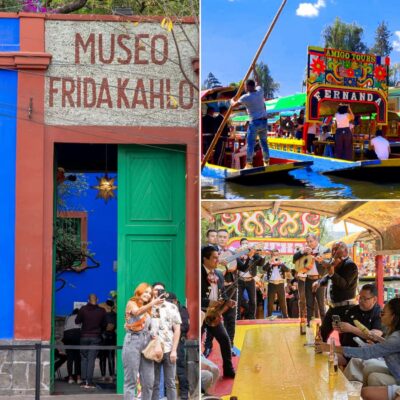
Xochimilco, Coyoacan, Frida Kahlo Museum & Murals Tour
Read our review →![Frida Kahlo VIP [Museum Tickets Included] Bike, Markets & Churros](https://9.mexicocityexplorer.com/wp-content/uploads/frida-kahlo-vip-museum-tickets-included-bike-markets-churros-400x300.jpg)
Frida Kahlo VIP [Museum Tickets Included] Bike, Markets & Churros
Read our review →![Frida Kahlo VIP [Museum Tickets Included] Walk, Markets & Churros](https://9.mexicocityexplorer.com/wp-content/uploads/frida-kahlo-vip-museum-tickets-included-walk-markets-churros-400x267.jpg)
Frida Kahlo VIP [Museum Tickets Included] Walk, Markets & Churros
Read our review →
EXCLUSIVE TOUR Frida Kahlo Museum – SMALL GROUPS
Read our review →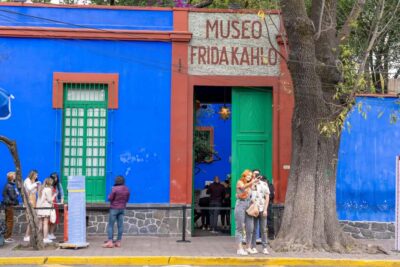
Frida Kahlo Museum Entry Ticket w/Digital Guide
Read our review →
Private City Tour in Frida Kahlo, Coyoacan, and Xochimilco
Read our review →
PREMIUM Frida Kahlo Museum and Xochimilco (Small Groups)
Read our review →Browse the lists this tour appears in