
Reviewed · HISTORIC CENTRE WALKING TOURS
Muralist Art Semi Private Walking Tour in Mexico City Downtown
Mexico City’s murals are not just large paintings on grand walls. They are public arguments about revolution, class, labor, religion, identity, and power. This walking tour gives you the tools to read them, taking you to works by Diego Rivera, José Clemente Orozco, and David Siqueiros that are easy to miss on your own.
I like two things here. First, the small maximum of eight people gives the guide room to answer questions and point out details high above your head. Second, the tour connects art with Mexican politics and social history, so the murals become more than colorful backdrops. The main drawback is simple: you will walk and stand for about three and a half hours, so comfortable shoes are essential.
In This Review
- Key points to know
- Why Mexico City’s murals deserve a guided walk
- Starting near Santo Domingo in Centro Histórico
- The Ministry of Education: Rivera in a working public setting
- Antiguo Colegio de San Ildefonso, the movement’s early home
- Palacio de Bellas Artes and its 17 murals
- What the guide adds beyond the paintings
- Is $58.12 a fair price?
- Timing, walking, and what to bring
- Who should book this mural tour?
- Should you book the Muralist Art Walking Tour?
- FAQ
- How long does the mural walking tour last?
- How much does the tour cost?
- What is included in the price?
- Is the tour offered in English?
- How many people can join the tour?
- Where does the tour begin?
- Where does the tour end?
- Is transportation included?
- Are museum admission tickets included?
- Can I cancel for a full refund?
Key points to know
- Three major mural sites: See the Ministry of Education, Antiguo Colegio de San Ildefonso, and Palacio de Bellas Artes.
- A lesson in Mexican muralism: Learn how Rivera, Orozco, Siqueiros, Jean Charlot, and other artists used public art to tell national stories.
- Small semi-private group: The tour accepts no more than eight people, and some departures may feel almost private.
- Museum admission included: Entry tickets to the buildings visited are part of the $58.12 price.
- Strong English guiding: The experience is offered in English with a certified bilingual guide. Emilio and Emiliano have been especially praised for their clear, thoughtful presentations.
- A walking tour with real substance: Expect art analysis, political context, questions, and plenty of time on your feet.
Why Mexico City’s murals deserve a guided walk
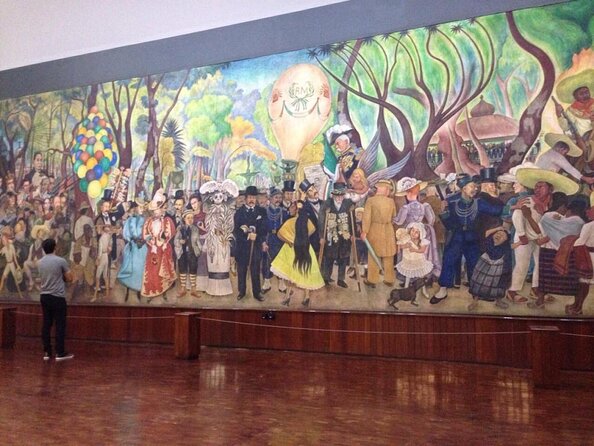
Mexico City is one of the best places in the world to see public art used as a record of a nation. The murals were not made simply to decorate government buildings and schools. They were designed to communicate with ordinary people, many of whom could not read. Scenes of workers, Indigenous communities, revolutionaries, colonizers, teachers, soldiers, and politicians appear side by side.
That makes these works rewarding but not always easy to read. A mural may contain dozens of figures, symbols, historical references, and arguments about Mexico’s past. Without context, you can admire the scale and colors while missing the point.
I like the way this tour treats the murals as both art and evidence. Your guide may ask what you see before explaining the scene, encouraging you to look closely rather than simply wait for a lecture. That approach makes the visit more active and helps you notice how the artists arranged people, gestures, clothing, and symbols.
The emphasis is not limited to Diego Rivera. You also encounter Orozco, Siqueiros, Jean Charlot, and other important muralists. Their styles and political views differ, which gives the tour more range than a single-artist introduction.
More walks through the historic centre:
- Historic Downtown Walking Tour
★ 5.0 · 1,289 reviews - Historic Center Food Tour in Mexico City
★ 5.0 · 1,263 reviews - Mexico City: Historic Downtown Walking Tour
★ 4.8 · 1,039 reviews
Starting near Santo Domingo in Centro Histórico
The meeting point is Portal de Escribanos near Santo Domingo in the Centro Histórico. You are responsible for reaching this point, since transportation to the start is not included. The tour ends inside the Mural Museum of Palacio de Bellas Artes on Avenida Juárez.
That start and finish make practical sense if you are already exploring central Mexico City. You begin among some of the city’s oldest streets and finish at one of its best-known cultural buildings. You do not return to the starting point, so plan the rest of your day from Bellas Artes rather than Santo Domingo.
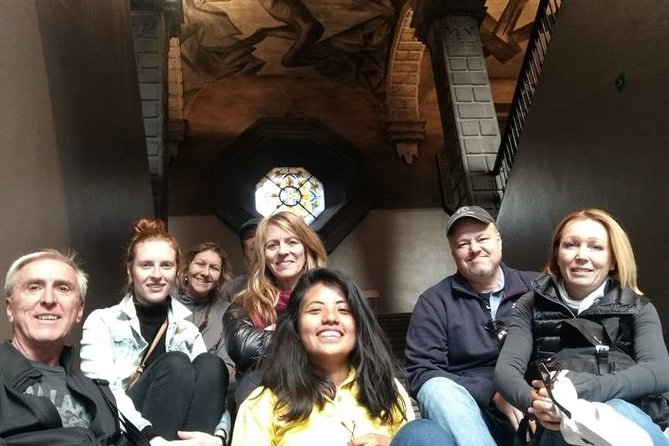
The tour is offered in English and uses a certified bilingual guide. The small group limit matters here. Murals require time to study, and a guide can lose the thread when a large crowd is constantly moving or asking questions. With no more than eight participants, the discussion can stay focused.
The exact guide may vary, but Emilio and Emiliano have received particular praise for their command of Mexican art, political history, and social issues. Emiliano has been described as especially clear in English, thoughtful in his interpretations, and willing to continue beyond the scheduled time when the conversation is still useful. That does not guarantee a particular guide, but it gives you a good sense of the guiding style to expect: serious, personal, and far more detailed than a quick photo stop.
The Ministry of Education: Rivera in a working public setting
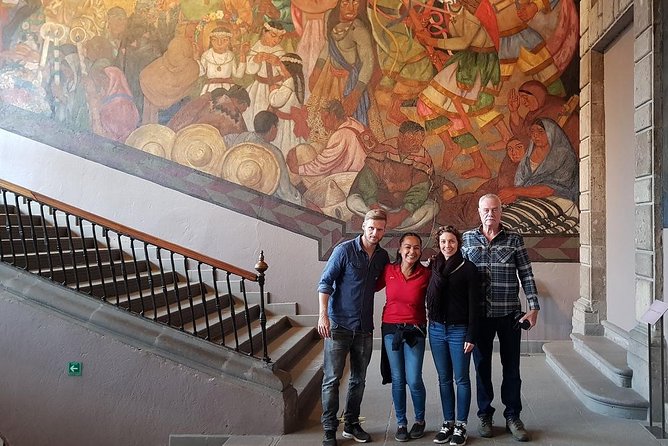
One of the first major stops is the Ministry of Education, a building filled with murals by Diego Rivera and other leading artists. This setting matters. The paintings are not isolated in a quiet gallery. They occupy an institutional space connected to education, government, workers, and national identity.
Rivera’s work often brings together scenes from Mexican life and history in a way that can feel crowded at first. A guide helps you sort the visual information. You may be directed toward a small figure, a repeated motif, or a relationship between two scenes that you would likely overlook while walking alone.
This is also a good place to understand Rivera’s role as a public artist. His murals were meant to reach people outside the traditional museum world. The location gives that idea practical force: the art is part of the building itself, not an object placed in a white-walled room.
Expect to spend time looking up, moving through the building, and comparing panels. The walls reward patience. If you prefer a quick look followed by a short explanation, this stop may feel slow. If you like asking why an image appears and what it says about Mexican society, it is one of the tour’s strongest sections.
Antiguo Colegio de San Ildefonso, the movement’s early home
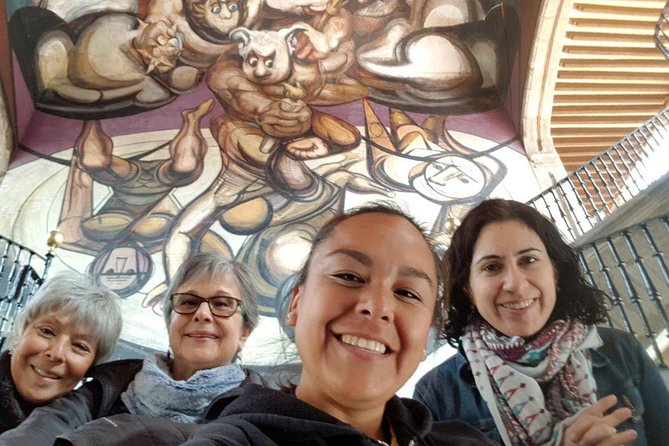
The Antiguo Colegio de San Ildefonso is allotted about an hour, with admission included. This former college is considered a cradle of the Mexican Muralist movement, and its walls include work by José Clemente Orozco, Diego Rivera, and Jean Charlot.
The building gives you a sense of how early muralism developed. Instead of seeing one famous panel in isolation, you can consider the relationship between architecture, scale, and movement. The murals occupy corridors and walls in a historic setting, so the experience feels closer to walking through a visual argument than visiting a standard exhibition.
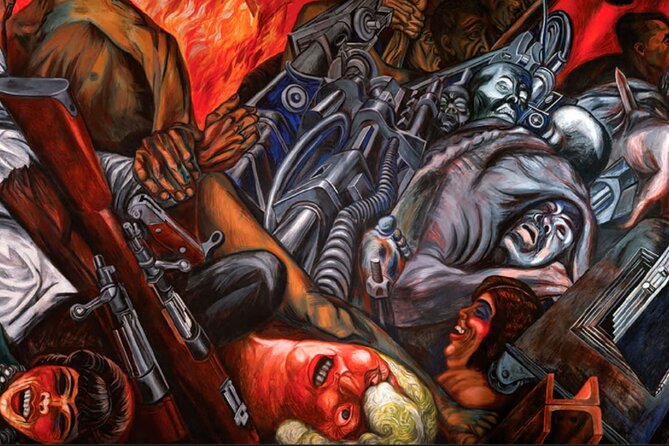
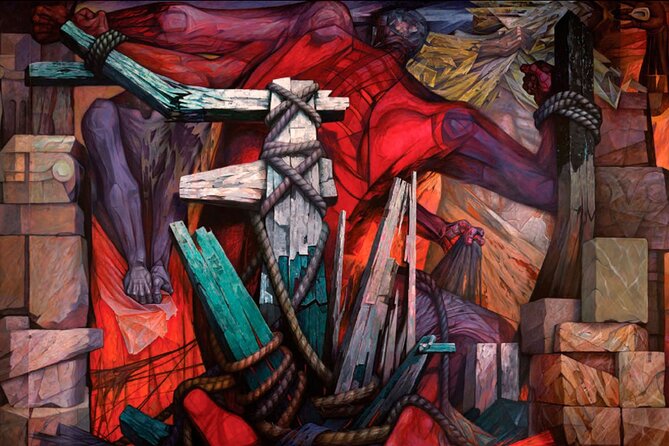
Orozco is especially important here. His work can be more tense and severe than Rivera’s, with a strong concern for violence, conflict, and the human cost of political upheaval. A good explanation helps you see how his figures and compositions create emotion without relying on a cheerful national story.
Jean Charlot adds another part of the movement’s story. Seeing his work alongside Rivera and Orozco makes clear that Mexican muralism was not the product of one artist working alone. It was a wider artistic conversation shaped by public commissions, national politics, education, and ideas about who art should serve.
The hour-long visit is useful because this is not a place to rush through in ten minutes. You will want time to study the walls and ask questions. You should also expect plenty of standing. The tour is accessible to most people according to the provided information, and service animals are allowed, but anyone with limited stamina should take the walking and standing seriously.
More walking tours in Mexico City:
- Frida Kahlo VIP [Museum Tickets Included] Walk, Markets & Churros
★ 5.0 · 982 reviews - Walking Tour of the Historic Center of Mexico City
★ 5.0 · 870 reviews - Anthropology Museum Private Experience Walking Tour
★ 5.0 · 355 reviews - Walking Tour in Mexico City for Exploring their Cultural Heritage
★ 5.0 · 245 reviews
Palacio de Bellas Artes and its 17 murals
The final major stop is Palacio de Bellas Artes, one of Mexico City’s most important artistic buildings. The tour ends inside the Mural Museum of Bellas Artes, and about an hour is set aside for the visit. Admission is included.
Inside, you can see 17 murals by different artists created over the years. This variety gives the final stop a broader frame. Instead of focusing on one building’s early mural program, you see how major Mexican muralists and later works are presented within an emblematic cultural setting.
Rivera, Orozco, and Siqueiros are central to the story. Their approaches differ in scale, movement, line, political force, and treatment of the human figure. A guide can help you compare them directly instead of treating each painting as a separate masterpiece with no connection to the others.
The end point is particularly useful because the tour has built up the historical background before you reach it. You are not simply being told that the murals are important. You have already discussed the movement’s goals, its relationship to Mexican society, and the artists’ different ways of presenting history.
You finish inside the museum, which is convenient if you want to continue looking at the murals after the tour. It also means the experience does not end with a walk back through the city. You can stay with the art, revisit a painting, or make Bellas Artes the next stop in your day.
What the guide adds beyond the paintings
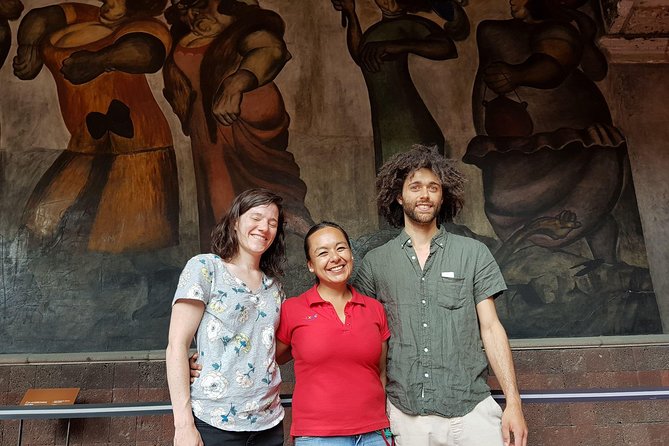
The greatest value here is interpretation. Anyone can enter a building and see a large Rivera mural. The harder part is understanding why the scene was painted, which people and events are shown, and how the work reflects arguments about Mexico.
The strongest guiding style on this tour combines three elements:
- Historical setting: You learn what was happening in Mexico when the work was made.
- Visual reading: You look at composition, figures, symbols, color, and scale.
- Present-day connection: You consider why these political and social themes still feel relevant.
This is not a tour for someone who wants only names and dates. The conversation may include social inequality, political conflict, the role of workers, religion, colonialism, and the ways governments use public art. Those subjects give the murals their force, but they also require attention.
I appreciate that the guide may ask for your interpretation instead of treating art as a puzzle with one official answer. You can say what you notice, then hear how the scene fits into its wider context. That exchange helps you form your own view while still gaining solid background.
Several visitors have found the discussion moving, especially when the murals’ political themes connect with current events. You should not expect a light sightseeing loop with constant jokes. The tone is warm and engaging, but the subject matter can be serious.
Is $58.12 a fair price?
At $58.12 per person, this is not the cheapest way to walk around Centro Histórico. The price includes entry tickets to all museums visited, a certified bilingual guide, and a three-and-a-half-hour experience with a maximum of eight people.
That package offers good value if you care about art and want the murals explained. Paying for admission separately would still leave you without the guide’s historical and visual background. The small group is also important. You are paying for access to a focused conversation, not just transportation between attractions.
The value is weaker if you plan to skim the murals, take a few photos, and move on. You may not want three hours of close looking and discussion. In that case, visiting one or two sites on your own could cost less and suit your pace better.
Group discounts are available, so the per-person cost may work better for friends or family booking together. The tour is also booked, on average, about 20 days ahead, which suggests you should reserve early if your Mexico City dates are fixed.
Timing, walking, and what to bring
The advertised duration is approximately three hours and 30 minutes. Some visits may run longer when the group has many questions or the guide continues the discussion. Build a little flexibility into your schedule rather than placing a tight lunch reservation immediately afterward.
Wear comfortable shoes. This is repeated practical advice for good reason. You will walk through central streets and spend long periods standing inside the buildings. The art rewards looking up and lingering, so shoes that are fine for a short city stroll may not be enough for the full outing.
Bring water and keep your belongings manageable. The tour does not include transportation to the meeting point, so use the city’s public transportation or arrange your own route to Portal de Escribanos. The meeting and ending points are near public transportation, but the experience itself is on foot.
You receive confirmation when booking. Service animals are allowed, and most people can participate, but the provided information does not promise a fully step-free route or specify seating at every stop. If mobility is a concern, contact the operator before reserving.
Free cancellation is available if you cancel at least 24 hours before the local start time. Changes or cancellations made inside that window are not accepted for a refund.
Who should book this mural tour?
I would choose this tour early in a Mexico City visit if you want art to help you understand the city. The guide’s explanations can give you a useful framework for later visits to museums, historic buildings, and public spaces.
It is particularly well suited to:
- People who enjoy art, architecture, and political history
- First-time visitors who want a focused introduction to Mexican muralism
- Solo visitors who value conversation and a small group
- Families with older children who can manage several hours of walking and standing
- Anyone interested in Rivera, Orozco, Siqueiros, or Jean Charlot
- Visitors who prefer careful interpretation over a fast list of attractions
It may not suit you if you dislike long explanations, have limited walking stamina, or want free time to explore each building alone. The tour has a clear subject and takes it seriously.
Should you book the Muralist Art Walking Tour?
Book it if you want to understand what you are seeing, not just photograph it. The included admissions and small group help justify the $58.12 price, while the route brings together three important sites in one well-organized morning or afternoon.
The best reason to go is the guide. Emilio and Emiliano have been praised for making complex art and history clear, answering questions with care, and encouraging close observation. A particular guide is not guaranteed, but the experience is built around that kind of personal interpretation.
Wear good shoes, allow more than three and a half hours, and arrive ready to look closely. If that sounds appealing, this is one of the strongest ways to meet Mexico City through its murals.
FAQ
How long does the mural walking tour last?
The tour lasts approximately three hours and 30 minutes. It may run longer if the group has many questions or the guide continues the discussion.
How much does the tour cost?
The listed price is $58.12 per person. Group discounts are available.
What is included in the price?
The price includes a certified bilingual guide and entrance tickets to all museums visited during the tour.
Is the tour offered in English?
Yes. The experience is offered in English, and the guide is bilingual.
How many people can join the tour?
The maximum group size is eight travelers.
Where does the tour begin?
The tour begins at Portal de Escribanos, near Santo Domingo in Mexico City’s Centro Histórico.
Where does the tour end?
The tour ends inside the Mural Museum of Palacio de Bellas Artes, at the Palacio de Bellas Artes on Avenida Juárez.
Is transportation included?
No. Transportation to the meeting point is not included. The meeting and ending areas are near public transportation.
Are museum admission tickets included?
Yes. Entrance tickets to all museums visited during the tour are included.
Can I cancel for a full refund?
Yes, if you cancel at least 24 hours before the experience’s start time. Cancellations or changes made less than 24 hours in advance are not accepted for a refund.
Just added around Mexico City
- Mexico City: Hop-on Hop-off City Tour by Turibus 2-Day Pass★ 4.0 · 10 reviews
- Anthropology Museum, Chapultepec Castle & Cable Car Tour★ 4.5 · 10 reviews
- Multi-Variety Mole Class in a Condesa home or art gallery rooftop★ 5.0 · 10 reviews
- PRIVATE TOUR Colonial Town Taxco and Cuernavaca from CDMX.★ 5.0 · 10 reviews
- El Centro Street Food Walking Tour★ 5.0 · 10 reviews
- Private Round-Trip Transportation to Teotihuacan Pyramids★ 5.0 · 10 reviews
- Teotihuacan and My Grandma’s Food Tour★ 5.0 · 10 reviews
- Teotihuacan Pyramids Tour from Mexico City★ 5.0 · 10 reviews
Historic Centre Walking Tours, compared.



Mexico City Layover Tour: Downtown City Sightseeing
Read our review →
Private Walking Tour Gems of the Historic Center of Mexico City
Read our review →Browse the lists this tour appears in